Vocabulary Lesson

French Body Vocabulary

In this short lesson, you'll master essential body vocabulary in French. After learning the words, use the flashcards or quiz to reinforce your knowledge.
A1-C1 Audio Included Quiz Flashcards
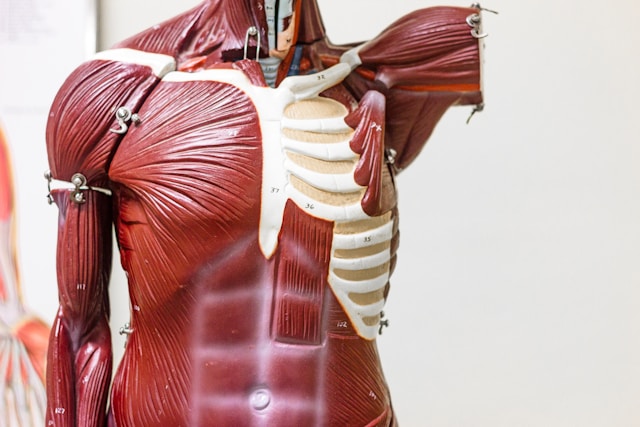
A photo of body}}

French Body Vocabulary

Start with the most common words, then expand your knowledge with intermediate and advanced vocabulary.

Beginner (A1)

  • stomach l'estomac
  • ear l'oreille
  • shoulder l'épaule
  • eye l'œil
  • mouth la bouche
  • tooth la dent
  • throat la gorge
  • leg la jambe
  • cheek la joue
  • tongue la langue
  • lip la lèvre
  • hand la main
  • skin la peau
  • chest la poitrine
  • head la tête
  • arm le bras
  • neck le cou
  • heart le cœur
  • finger le doigt
  • back le dos
  • forehead le front
  • knee le genou
  • nose le nez
  • foot le pied
  • hair les cheveux

Elementary (A2)

  • fingernail l'ongle
  • toe l'orteil
  • bone l'os
  • beard la barbe
  • ankle la cheville
  • thigh la cuisse
  • hip la hanche
  • mustache la moustache
  • waist la taille
  • brain le cerveau
  • eyelash le cil
  • elbow le coude
  • chin le menton
  • calf le mollet
  • muscle le muscle
  • navel le nombril
  • wrist le poignet
  • breast le sein
  • eyebrow le sourcil
  • heel le talon
  • buttocks les fesses

Intermediate & Advanced (B1-C1)

  • abdomen l'abdomen
  • groin l'aine
  • armpit l'aisselle
  • joint l'articulation
  • intestine l'intestin
  • rib la côte
  • buttocks les fesses
  • jaw la mâchoire
  • nostril la narine
  • palm la paume
  • eyelid la paupière
  • sole la plante
  • pupil la pupille
  • freckle la tache de rousseur
  • temple la tempe
  • skull le crâne
  • liver le foie
  • mole le grain de beauté
  • nerve le nerf
  • lung le poumon
  • shin le tibia
  • artery l'artère
  • crotch l'entrejambe
  • small intestine l'intestin grêle
  • iris l'iris
  • spine la colonne vertébrale
  • spleen la rate
  • vein la veine
  • bladder la vessie
  • pelvis le bassin
  • diaphragm le diaphragme
  • large intestine le gros intestin
  • pancreas le pancréas
  • kidney le rein
  • tendon le tendon

Practice What You've Learned

Review your French body vocabulary and test your knowledge with interactive practice.

Ready to take the quiz?

Put your new body vocabulary into practice and see how many words you can remember.

Take the quiz

Practice with flashcards

Review French body vocabulary and strengthen your memory with interactive flashcards.

Open flashcards

Example Sentences

In proper context. With highlighted verbs and adjectives.

Beginner & Elementary (A1-A2)

Basic sentences featuring common verbs and adjectives used when discussing the human body.

  • Je me lave les mains avant de manger. I wash my hands before eating.
  • Il ferme les yeux pour dormir. He closes his eyes to sleep.
  • Elle plie le coude pour porter le sac. She bends her elbow to carry the bag.
  • Le médecin examine ma gorge rouge. The doctor examines my red throat.
  • Nous massons notre dos après le travail. We massage our back after work.
  • Mon bras droit est très fort. My right arm is very strong.
  • Il a la peau très douce. He has very soft skin.
  • Mes cheveux sont longs et noirs. My hair is long and black.
  • Son genou gauche est gonflé. His left knee is swollen.
  • Cette dent est encore sensible. This tooth is still sensitive.

Intermediate & Advanced (B1-C1)

More complex anatomical contexts using descriptive adjectives and medical or active verbs.

  • Le chirurgien opère le rein du patient ce matin. The surgeon is operating on the patient's kidney this morning.
  • Elle étire ses cuisses après une longue course. She stretches her thighs after a long run.
  • Mon cœur bat rapidement après cet effort intense. My heart beats rapidly after this intense effort.
  • Il se fracture le tibia pendant le match. He fractures his shin bone during the match.
  • La fumée irrite mes poumons et mes yeux. The smoke irritates my lungs and my eyes.
  • L'artère principale reste bien flexible. The main artery remains quite flexible.
  • Sa mâchoire inférieure est légèrement asymétrique. Her lower jaw is slightly asymmetrical.
  • Le muscle cardiaque est extrêmement résistant. The heart muscle is extremely resilient.
  • Sa colonne vertébrale est parfaitement droite. His spinal column is perfectly straight.
  • L'intestin grêle est particulièrement long. The small intestine is particularly long.

Frequently Asked Questions

Frequently asked questions about body vocabulary in French

To say that a part of your body hurts, use the expression avoir mal à followed by the definite article and the body part:

  • J'ai mal au ventre (masculine singular: à + le = au) – My stomach hurts.
  • J'ai mal à la tête (feminine singular) – I have a headache.
  • J'ai mal à l'épaule (singular starting with a vowel) – My shoulder hurts.
  • J'ai mal aux pieds (plural: à + les = aux) – My feet hurt.

In English, we say 'I wash my hands', but in French, reflexive verbs with definite articles are standard when referring to one's own body:

  • Je me lave les mains (NOT je lave mes mains) – I wash my hands.
  • Elle s'est cassé la jambe (NOT elle a cassé sa jambe) – She broke her leg.
  • Il s'ouvre les yeux – He opens his eyes.

French features many picturesque idioms centered on human anatomy:

  • Coûter les yeux de la tête – To cost an arm and a leg (literally: to cost the eyes from the head).
  • Avoir les yeux plus gros que le ventre – To have eyes bigger than one's stomach.
  • Avoir la tête dans les nuages – To have one's head in the clouds.
  • Mon petit doigt m'a dit... – A little bird told me... (literally: my little finger told me).

When describing physical features like hair (les cheveux) or eyes (les yeux), adjectives must agree in gender and number, with a few exceptions:

  • Les yeux bleus / verts / noirs – Blue / green / black eyes (masculine plural agreement).
  • Les cheveux blonds / bruns / buissons – Blonde / brown hair.
  • Les yeux marron – Brown eyes (marron is an invariable noun-derived color, so no 's' is added).

Here are key verbs used when describing movement, care, or bodily sensations:

  • Plier / Tendre – To bend / To stretch (e.g., plier le genou).
  • Masser / Toucher – To massage / To touch.
  • Frotter / Gratter – To rub / To scratch.
  • Respirer / Haleter – To breathe / To pant.

Explore All French Lessons

Browse all French vocabulary lessons, quizzes, grammar guides, and learning resources.

Browse All Lessons

Photo by Alan Calvert on Unsplash