Vocabulary Lesson

French Colors Vocabulary

In this short lesson, you'll master essential colors vocabulary in French. After learning the words, use the flashcards or quiz to reinforce your knowledge.
A1-C1 Audio Included Quiz Flashcards
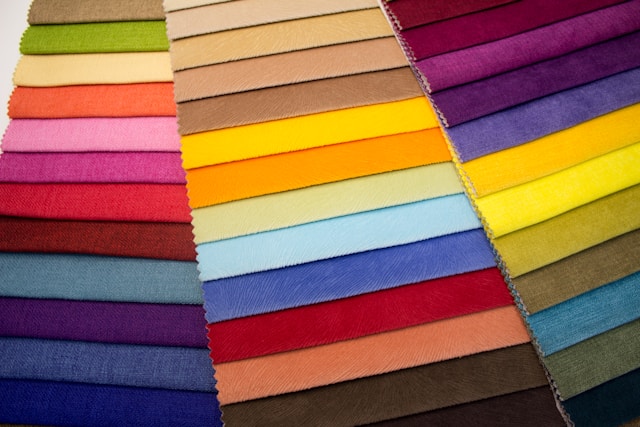
A photo of colors}}

French Colors Vocabulary

Start with the most common words, then expand your knowledge with intermediate and advanced vocabulary.

Beginner (A1)

  • black noir
  • blue bleu
  • brown marron
  • gray gris
  • green vert
  • orange orange
  • pink rose
  • purple violet
  • red rouge
  • white blanc
  • yellow jaune

Elementary (A2)

  • beige beige
  • cyan cyan
  • dark blue bleu foncé
  • dark green vert foncé
  • gold doré
  • light blue bleu clair
  • silver argent
  • turquoise turquoise

Intermediate & Advanced (B1-C1)

  • chartreuse vert chartreuse
  • fuchsia fuchsia
  • lavender lavande
  • lime green vert citron
  • maroon bordeaux
  • mauve mauve
  • navy blue bleu marine
  • olive green vert olive
  • sky blue bleu ciel
  • slate gray gris ardoise
  • tan beige
  • chocolate brown marron chocolat
  • emerald émeraude
  • indigo indigo
  • indigo blue bleu indigo
  • ivory ivoire
  • khaki kaki
  • mint green vert menthe
  • mustard yellow jaune moutarde
  • off‑white blanc cassé
  • periwinkle pervenche
  • rust rouille
  • salmon pink rose saumon
  • slate ardoise
  • steel blue bleu acier
  • mother‑of‑pearl nacre
  • sapphire saphir

Practice What You've Learned

Review your French colors vocabulary and test your knowledge with interactive practice.

Ready to take the quiz?

Put your new colors vocabulary into practice and see how many words you can remember.

Take the quiz

Practice with flashcards

Review French colors vocabulary and strengthen your memory with interactive flashcards.

Open flashcards

Example Sentences

In proper context. With highlighted verbs and adjectives.

Beginner & Elementary (A1-A2)

Useful everyday sentences featuring simple colors, verbs, and adjectives.

  • Elle porte une chemise rouge. She is wearing a red shirt.
  • L'enfant dessine une fleur jaune. The child is drawing a yellow flower.
  • Il choisit un pantalon bleu. He chooses blue pants.
  • Ma mère achète un sac vert. My mother buys a green bag.
  • Je préfère la voiture blanche. I prefer the white car.
  • Ce manteau est rouge. This coat is red.
  • Le mur de la chambre est vert. The bedroom wall is green.
  • Mon chat est totalement noir. My cat is completely black.
  • Elle aime ce bleu clair. She likes this light blue.
  • Le ciel devenait très foncé. The sky was becoming very dark.

Intermediate & Advanced (B1-C1)

More complex sentences featuring nuanced shades, descriptive verbs, and descriptive adjectives.

  • L'architecte cherche à harmoniser ces nuances de violet. The architect seeks to harmonize these shades of purple.
  • Nous allons repeindre le salon en vert olive. We are going to repaint the living room in olive green.
  • Cette teinte de lavande évoque la beauté de la Provence. This shade of lavender evokes the beauty of Provence.
  • Il faut mélanger du jaune et du bleu pour obtenir du vert. You have to mix yellow and blue to get green.
  • Le soleil risque de ternir la couleur de ces rideaux. The sun risks dulling the color of these curtains.
  • La robe a une délicate teinte rose poudré. The dress has a delicate dusty pink shade.
  • Cet appartement est très lumineux grâce aux murs blancs. This apartment is very bright thanks to the white walls.
  • Les fleurs d'un jaune éclatant attirent les papillons. The bright yellow flowers attract butterflies.
  • Elle préfère les tons pastel pour décorer sa maison. She prefers pastel tones to decorate her house.
  • Par ce temps gris, le paysage semble terne. In this gray weather, the landscape seems dull.

Frequently Asked Questions

Everything you need to know about using color words, grammar rules, and expressions in French.

Color agreement rules in French depend on whether the color word is a simple adjective or derived from a noun.

  • Simple adjectives like rouge, bleu, vert, and blanc agree in gender and number (e.g., des chemises bleues).
  • Color adjectives derived from nouns (like marron, orange) are invariable and never change form.
  • Compound colors (like bleu foncé or vert clair) remain invariable regardless of gender or plural forms.

While both translate to brown in English, they are used in distinct context across the French language.

  • Marron is used for everyday objects, clothes, and eye color (e.g., des yeux marron, une table marron).
  • Brun is primarily used for hair color, skin tone, animal fur, or dark beer (e.g., une personne brune, de la bière brune).
  • Note that marron is invariable, whereas brun agrees in gender and number (e.g., des bottes brunes).

When describing precise shades using multiple words, French follows specific grammatical guidelines.

  • When combining a color with an intensity word (like foncé or clair), both words remain invariable (e.g., des vestes bleu clair).
  • When combining two color terms (like bleu-vert), both words remain invariable.
  • When using fruit or mineral modifiers (like vert menthe or rose saumon), the entire phrase stays invariable.

Colors appear frequently in figurative expressions throughout idiomatic French.

  • Être dans le rouge means to be overdrawn or in debt.
  • Rire jaune means to give a forced or embarrassed smile.
  • Avoir une peur bleue means to be terrified or scared stiff.
  • Voir la vie en rose means to look at life through rose-colored glasses.

Unlike some common descriptive adjectives that precede the noun, color adjectives almost always follow the noun.

  • Standard word order: un ballon rouge (a red ball), une fleur jaune (a yellow flower).
  • If multiple adjectives describe the noun, the color adjective stays directly after the noun or adjacent descriptive words.
  • When using colors as nouns with verbs, prepositions are commonly used (e.g., peindre en vert - to paint in green).

Explore All French Lessons

Browse all French vocabulary lessons, quizzes, grammar guides, and learning resources.

Browse All Lessons

Photo by Ekaterina Grosheva on Unsplash