Vocabulary Lesson

French Days and Months Vocabulary

In this short lesson, you'll master essential days and months vocabulary in French. After learning the words, use the flashcards or quiz to reinforce your knowledge.
A1-C1 Audio Included Quiz Flashcards
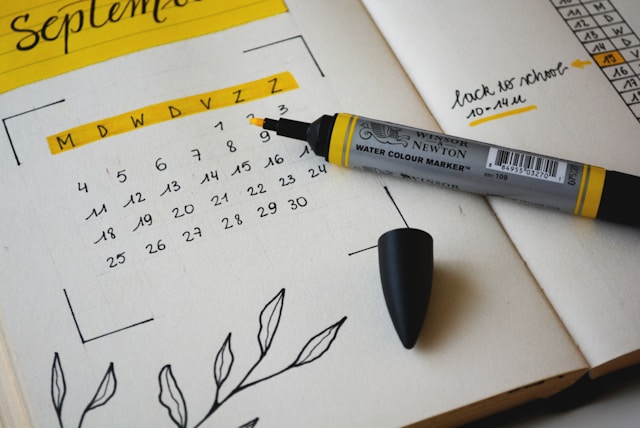
A photo of days and months vocabulary in French

French Days and Months Vocabulary

Start with the most common words, then expand your knowledge with intermediate and advanced vocabulary.

Beginner (A1)

  • today aujourd'hui
  • tomorrow demain
  • yesterday hier
  • year l'année
  • autumn l'automne
  • winter l'hiver
  • summer l'été
  • spring le printemps
  • date la date
  • day le jour
  • night la nuit
  • morning le matin
  • afternoon l'après-midi
  • week la semaine
  • season la saison
  • January janvier
  • February février
  • March mars
  • April avril
  • May mai
  • June juin
  • July juillet
  • August août
  • September septembre
  • October octobre
  • November novembre
  • December décembre
  • Monday lundi
  • Tuesday mardi
  • Wednesday mercredi
  • Thursday jeudi
  • Friday vendredi
  • Saturday samedi
  • Sunday dimanche
  • midday le midi
  • midnight minuit
  • month le mois
  • evening le soir
  • weekend le week-end

Elementary (A2)

  • day after tomorrow après-demain
  • day before yesterday avant-hier
  • dawn l'aube
  • calendar le calendrier
  • workday le jour de travail
  • holiday le jour férié
  • schedule emploi du temps

Intermediate & Advanced (B1-C1)

  • decade la décennie
  • fortnight la quinzaine
  • dusk le crépuscule
  • weekday le jour ouvrable
  • semester le semestre
  • quarter le trimestre
  • era l'ère
  • century le siècle

Practice What You've Learned

Review your French days-and-months vocabulary and test your knowledge with interactive practice.

Ready to take the quiz?

Put your new days-and-months vocabulary into practice and see how many words you can remember.

Take the quiz

Practice with flashcards

Review French days-and-months vocabulary and strengthen your memory with interactive flashcards.

Open flashcards

Example Sentences

In proper context. With highlighted verbs and adjectives.

Beginner & Elementary (A1-A2)

Fundamental sentences using days, months, and basic time expressions.

  • Le mois de janvier commence lundi. The month of January begins on Monday.
  • L'été finit en septembre. Summer ends in September.
  • Nous partons en vacances en juillet. We are leaving on vacation in July.
  • Est-ce que tu travailles samedi matin ? Are you working Saturday morning?
  • Il neige souvent en décembre. It often snows in December.
  • Le mois d'août est très chaud. The month of August is very hot.
  • La nuit de février est froide. The February night is cold.
  • Nous nous voyons lundi prochain. We will see each other next Monday.
  • J'ai visité Paris le mois dernier. I visited Paris last month.
  • Demain est un jour férié. Tomorrow is a public holiday.

Intermediate & Advanced (B1-C1)

More advanced expressions related to dates, calendars, and time cycles.

  • L'emploi du temps prévoit une réunion mardi après-midi. The schedule foresees a meeting on Tuesday afternoon.
  • La formation dure toute une quinzaine. The training lasts a whole fortnight.
  • Nous célébrerons notre anniversaire au crépuscule. We will celebrate our anniversary at dusk.
  • Elle consacre chaque jour ouvrable à ses recherches. She devotes every weekday to her research.
  • L'aube marque le début d'une nouvelle ère. Dawn marks the beginning of a new era.
  • Le bilan mensuel sera présenté la semaine prochaine. The monthly report will be presented next week.
  • Ce festival est un événement annuel très populaire. This festival is a very popular annual event.
  • Nous avons profité d'un après-midi ensoleillé au printemps. We enjoyed a sunny afternoon in spring.
  • Les températures estivales sont particulièrement élevées cette année. Summer temperatures are particularly high this year.
  • La lecture de la presse fait partie de son rythme quotidien. Reading the press is part of his daily rhythm.

Frequently Asked Questions

Essential rules and tips for expressing dates, months, days, and time expressions in French.

Expressing dates in French follows a straightforward rule, but differs slightly from English structure:

  • Format order: Use day + number + month (+ year), for example: le 14 juillet 2024.
  • Months are lowercased: Unlike English, month names in French do not start with a capital letter (e.g., mai, décembre).
  • First day of the month: Use le premier (e.g., le 1er mai), but use regular cardinal numbers for all other days (e.g., le 2 juin).
  • Asking the date: You can ask « Quelle est la date aujourd'hui ? » or « On est quel jour ? ».

No, in French, days of the week are written in lowercase unless they appear at the very beginning of a sentence.

  • Examples: Write lundi, mardi, vendredi, not Lundi or Vendredi.
  • Using articles with days: Saying « Je travaille lundi » means 'I am working this coming Monday', while « Je travaille le lundi » means 'I work every Monday'.
  • Prepositions: Do not use en or on before days of the week in French (say « Je viens samedi », not « Je viens en samedi »).

Choosing the correct preposition depends on whether you are talking about a month, a season, or a year:

  • Months: Use en or au mois de (e.g., en avril or au mois d'avril).
  • Years: Always use en (e.g., en 2025).
  • Seasons starting with consonants: Use au for spring (au printemps).
  • Seasons starting with vowels: Use en for summer, autumn, and winter (en été, en automne, en hiver).

French distinguishes between a unit of time as a point/count and a duration/experience:

  • Un an / Un jour: Refers to a simple unit of measure or point in time (e.g., J'ai trente ans, J'arrive dans trois jours).
  • Une année / Une journée: Emphasizes the duration, progression, or content of time spent (e.g., Passe une bonne journée !, Une année formidable).
  • Modifiers: Adjectives usually pair with the feminine form (e.g., l'année dernière, toute la journée).

French has specific terms and expressions for different periods throughout the day:

  • Main periods: le matin (morning), l'après-midi (afternoon), le soir (evening), la nuit (night).
  • Specific times: le midi (noon / midday) and minuit (midnight).
  • Transitional periods: l'aube (dawn) and le crépuscule (dusk).
  • Greetings: Use « Bonjour » during the day, and switch to « Bonsoir » in the evening.

Explore All French Lessons

Browse all French vocabulary lessons, quizzes, grammar guides, and learning resources.

Browse All Lessons

Photo by Estée Janssens on Unsplash