Vocabulary Lesson

French Food Vocabulary

In this short lesson, you'll master essential food vocabulary in French. After learning the words, use the flashcards or quiz to reinforce your knowledge.
A1-C1 Audio Included Quiz Flashcards
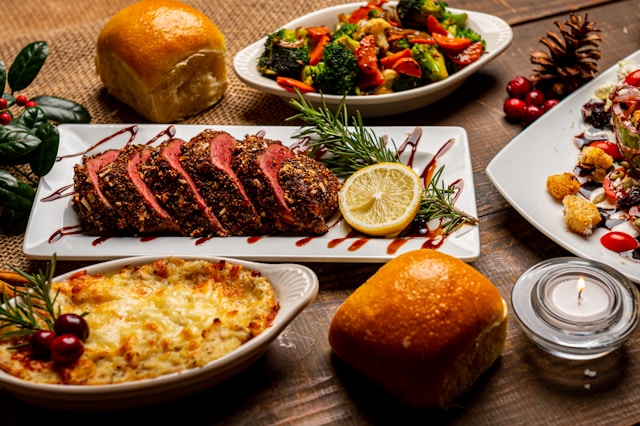
A photo of food}}

French Food Vocabulary

Start with the most common words, then expand your knowledge with intermediate and advanced vocabulary.

Beginner (A1)

  • oil l'huile
  • jam la confiture
  • cream la crème
  • pancake la crêpe
  • sauce la sauce
  • sausage la saucisse
  • soup la soupe
  • pie la tarte
  • meat la viande
  • butter le beurre
  • cookie le biscuit
  • candy le bonbon
  • beef le bœuf
  • chocolate le chocolat
  • croissant le croissant
  • dessert le dessert
  • breakfast le petit déjeuner
  • lunch le déjeuner
  • dinner le dîner
  • cheese le fromage
  • cake le gâteau
  • ham le jambon
  • bread le pain
  • toast le pain grillé
  • fish le poisson
  • pepper le poivre
  • pork le porc
  • chicken le poulet
  • meal le repas
  • rice le riz
  • salt le sel
  • sugar le sucre
  • yogurt le yaourt
  • cereal les céréales
  • noodles les pâtes
  • eggs les œufs

Elementary (A2)

  • lamb l'agneau
  • almond l'amande
  • herb l'herbe
  • ingredient l'ingrédient
  • olive l'olive
  • spice l'épice
  • brioche la brioche
  • shrimp la crevette
  • dairy la crémerie
  • turkey la dinde
  • flour la farine
  • waffle la gaufre
  • mayonnaise la mayonnaise
  • mussel la moule
  • mustard la moutarde
  • nut la noix
  • portion la portion
  • dough la pâte
  • pastry la pâtisserie
  • minced meat la viande hachée
  • duck le canard
  • snack le casse-croûte
  • mushroom le champignon
  • pickle le cornichon
  • crab le crabe
  • ketchup le ketchup
  • rabbit le lapin
  • bacon le lard
  • honey le miel
  • stew le ragoût
  • tofu le tofu
  • vinegar le vinaigre
  • seafood les fruits de mer

Intermediate & Advanced (B1-C1)

  • peanut l'arachide
  • oyster l'huître
  • yeast la levure
  • clam la palourde
  • stock le bouillon
  • icing le glaçage
  • lobster le homard
  • gravy le jus
  • pâté le pâté
  • sieve le tamis
  • veal le veau
  • scallop la coquille Saint-Jacques
  • foie gras le foie gras
  • game le gibier

Practice What You've Learned

Review your French food vocabulary and test your knowledge with interactive practice.

Ready to take the quiz?

Put your new food vocabulary into practice and see how many words you can remember.

Take the quiz

Practice with flashcards

Review French food vocabulary and strengthen your memory with interactive flashcards.

Open flashcards

Example Sentences

In proper context. With highlighted verbs and adjectives.

Beginner & Elementary (A1-A2)

Basic French verbs and adjectives used in everyday dining and food preparation.

  • Tu manges du pain au petit déjeuner. You eat bread for breakfast.
  • Elle cuisine de la soupe chaude. She cooks hot soup.
  • Le chef prépare un gâteau au chocolat. The chef prepares a chocolate cake.
  • Il achète du fromage au marché. He buys cheese at the market.
  • Tu coupes la viande avec un couteau. You cut the meat with a knife.
  • Ce poisson est très frais. This fish is very fresh.
  • Le chocolat est bien chaud. The chocolate is nice and hot.
  • Ce biscuit est très sucré. This cookie is very sweet.
  • Le beurre est un peu salé. The butter is a bit salty.
  • Ce plat de poulet est délicieux. This chicken dish is delicious.

Intermediate & Advanced (B1-C1)

More complex verbs and adjectives for culinary contexts.

  • Le cuisinier assaisonne le bouillon avec des herbes. The cook seasons the broth with herbs.
  • La sauce au vin mijote doucement dans la casserole. The wine sauce simmers gently in the saucepan.
  • La volaille dore lentement au four. The poultry browns slowly in the oven.
  • On déguste ce foie gras avec du pain grillé. We enjoy this foie gras with toasted bread.
  • Elle mélange la farine et la levure dans un saladier. She mixes the flour and yeast in a mixing bowl.
  • Ce ragoût d'agneau est particulièrement savoureux. This lamb stew is particularly flavorful.
  • Cette brioche est très moelleuse. This brioche is very soft and tender.
  • Ce plat de gibier est légèrement épicé. This game dish is slightly spiced.
  • Le pain frais possède une croûte croustillante. Fresh bread has a crispy crust.
  • Cette sauce à la crème est extrêmement onctueuse. This cream sauce is extremely creamy.

Frequently Asked Questions

Frequently asked questions about French food vocabulary and culinary terminology

Meal times are central to French daily culture. Here are the main terms and conventions used:

  • Le petit déjeuner – Breakfast (often light: bread, croissants, jam, coffee or tea).
  • Le déjeuner – Lunch (traditionally a sit-down meal eaten around mid-day).
  • Le goûter / Le quatre-heures – An afternoon sweet snack popular with children and adults.
  • Le dîner – Dinner (the main evening meal).
  • Use the verb prendre (to take/have) when eating a meal, for example: Je prends mon petit déjeuner à huit heures.

When referring to unspecified quantities of food or drink, French uses partitive articles instead of simple direct articles:

  • Du before masculine singular nouns: du pain (some bread), du beurre (some butter).
  • De la before feminine singular nouns: de la confiture (some jam), de la viande (some meat).
  • De l' before nouns starting with a vowel or silent h: de l'huile (some oil), de l'agneau (some lamb).
  • Des before plural nouns: des œufs (some eggs), des pâtes (some pasta).
  • In negative sentences, all partitive articles switch to de / d': Je ne mange pas de viande.

Here are essential culinary verbs to help you read French recipes and discuss cooking:

  • Manger – To eat.
  • Cuisiner / Cuire – To cook / to bake or heat food.
  • Mijoter – To simmer slowly over low heat.
  • Assaisonner – To season with spices, salt, pepper, or herbs.
  • Déguster – To savor, taste, or sample food or drink attentively.

Describing taste and texture is an important skill when dining in French-speaking countries:

  • Sucré / Salé – Sweet / Salty (or savory).
  • Épicé / Piquant – Spiced / Spicy or hot.
  • Croustillant – Crispy or crunchy (such as a fresh baguette crust).
  • Moelleux / Onctueux – Soft and tender (for pastries) or smooth and creamy (for sauces).
  • Frais / Fraîche – Fresh.

Yes, French-speaking regions across Europe and North America frequently use different lexical terms for everyday food items:

  • Pain au chocolat vs. Chocolatine – The famous regional difference between northern/central France and southwestern France for chocolate croissants.
  • Le déjeuner / Le dîner / Le souper – In Quebec, Switzerland, and Belgium, le déjeuner means breakfast, le dîner means lunch, and le souper means dinner.
  • La pastèque (France) vs. Le melon d'eau (Quebec) for watermelon.
  • La boisson (France) vs. Le breuvage (Quebec) for a drink.

Explore All French Lessons

Browse all French vocabulary lessons, quizzes, grammar guides, and learning resources.

Browse All Lessons

Photo by Jed Owen on Unsplash