Vocabulary Lesson

French Sports Vocabulary

In this short lesson, you'll master essential sports vocabulary in French. After learning the words, use the flashcards or quiz to reinforce your knowledge.
A1-C1 Audio Included Quiz Flashcards
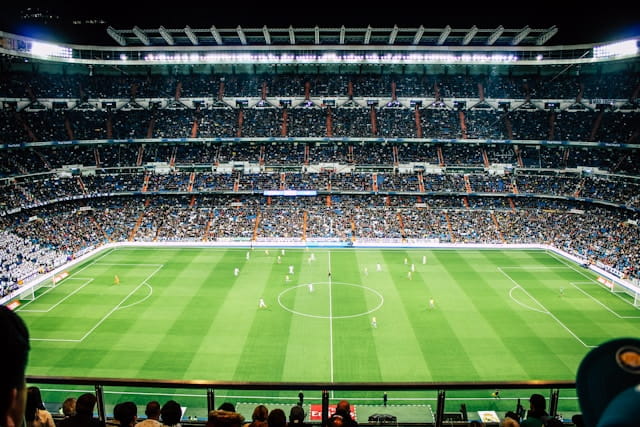
A photo of sports}}

French Sports Vocabulary

Start with the most common words, then expand your knowledge with intermediate and advanced vocabulary.

Beginner (A1)

  • team l'équipe
  • shoe la chaussure
  • race la course
  • pool la piscine
  • ball le ballon
  • goal le but
  • glove le gant
  • player le joueur/la joueuse
  • match le match
  • skate le patin
  • score le score
  • ski le ski
  • sport le sport
  • field le terrain
  • bicycle le vélo

Elementary (A2)

  • training l'entraînement
  • coach l'entraîneur/l'entraîneuse
  • bat la batte
  • competition la compétition
  • foul la faute
  • final la finale
  • round la manche
  • medal la médaille
  • ice rink la patinoire
  • track la piste
  • racket la raquette
  • mountain bike le VTT
  • ski pole le bâton de ski
  • schedule l’horaire
  • captain le capitaine
  • helmet le casque
  • champion le champion/la championne
  • court le court
  • cycling le cyclisme
  • net le filet
  • uniform l'uniforme
  • marathon le marathon
  • record le record
  • whistle le sifflet
  • snowboard le snowboard
  • spectator le spectateur/la spectatrice
  • athlete le sportif/la sportive
  • stadium le stade
  • fan le supporter/la supportrice

Intermediate & Advanced (B1-C1)

  • referee l'arbitre
  • warm-up l'échauffement
  • injury la blessure
  • hockey stick la crosse
  • semi-final la demi-finale
  • defeat la défaite
  • hurdle la haie
  • finish line la ligne d'arrivée
  • starting line la ligne de départ
  • league la ligue
  • halftime la mi-temps
  • victory la victoire
  • swimming cap le bonnet de bain
  • championship le championnat
  • lane le couloir
  • punch le coup de poing
  • glove (boxing) le gant de boxe
  • gymnasium le gymnase
  • draw le match nul
  • puck le palet
  • penalty le penalty
  • dive le plongeon
  • quarter-final le quart de finale
  • relay le relais
  • substitute le remplaçant/la remplaçante
  • boxing ring le ring
  • sponsor le sponsor
  • tournament le tournoi
  • trophy le trophée
  • baton le témoin
  • goggles les lunettes de natation
  • synchronized swimming la natation synchronisée
  • qualifier la qualification
  • discus le disque
  • javelin le javelot
  • shot put le poids
  • high jump le saut en hauteur
  • long jump le saut en longueur
  • pole vault le saut à la perche
  • extra time les prolongations

Practice What You've Learned

Review your French sports vocabulary and test your knowledge with interactive practice.

Ready to take the quiz?

Put your new sports vocabulary into practice and see how many words you can remember.

Take the quiz

Practice with flashcards

Review French sports vocabulary and strengthen your memory with interactive flashcards.

Open flashcards

Example Sentences

In proper context. With highlighted verbs and adjectives.

Beginner & Elementary (A1-A2)

Essential verbs and adjectives used in everyday sports situations.

  • Paul joue au football avec ses amis sur le terrain. Paul plays soccer with his friends on the field.
  • La joueuse court très vite vers la ligne d'arrivée. The player runs very fast toward the finish line.
  • L'attaquant marque un but magnifique pendant le match. The forward scores a wonderful goal during the match.
  • Cette équipe gagne la compétition cette année. This team wins the competition this year.
  • Le jeune athlète saute très haut au-dessus du filet. The young athlete jumps very high over the net.
  • Ce coureur est très rapide sur la piste. This runner is very fast on the track.
  • J'ai acheté un ballon neuf pour le match de demain. I bought a new ball for tomorrow's match.
  • Le capitaine de l'équipe est très fort. The team captain is very strong.
  • Le stade de la ville est très grand. The city stadium is very large.
  • Le maillot est trop chaud pour courir en été. The jersey is too warm for running in summer.

Intermediate & Advanced (B1-C1)

More complex actions and descriptions in sports context.

  • L'équipe française affronte un adversaire redoutable en demi-finale. The French team faces a formidable opponent in the semi-final.
  • L'arbitre siffle la fin de la mi-temps après une faute. The referee blows the whistle for the end of halftime after a foul.
  • Le champion subit une grave blessure lors de l'entraînement. The champion suffers a serious injury during training.
  • Le nageur remporte la médaille d'or au terme d'une finale intense. The swimmer wins the gold medal at the end of an intense final.
  • Le boxeur esquive adroitement le coup de poing de son rival. The boxer skillfully dodges his rival's punch.
  • L'entraînement physique de ce matin était particulièrement intense. This morning's physical training was particularly intense.
  • Le remplaçant a marqué le but décisif pendant les prolongations. The substitute scored the decisive goal during extra time.
  • La défaite était douloureuse pour tous les supporters rassemblés dans le stade. The defeat was painful for all the fans gathered in the stadium.
  • Le sponsor a présenté le nouvel uniforme officiel du club. The sponsor presented the club's official new uniform.
  • Le saut à la perche de cet athlète était vraiment impressionnant. That athlete's pole vault was truly impressive.

Frequently Asked Questions

Frequently asked questions about French sports vocabulary

In French, talking about practicing sports requires choosing between two primary verbs: faire and jouer.

  • Use jouer à for team sports or games played with a ball, racket, or puck (e.g., jouer au football, jouer au tennis).
  • Use faire de for individual activities, exercise routines, or outdoor sports (e.g., faire de la natation, faire du vélo, faire du ski).
  • Remember mandatory contractions: jouer au (à + le), jouer aux (à + les), faire du (de + le), and faire des (de + les).

Both translate to 'ball' in English, but French strictly differentiates them by size and discipline.

  • Le ballon refers to large, inflatable balls used in team sports like soccer, basketball, rugby, and volleyball.
  • La balle refers to smaller, solid or rubber balls used in tennis, golf, baseball, table tennis, or squash.
  • Note: A badminton shuttlecock is called un volant, not a balle.

Expressing scores and match results relies on specific French verbs and formulas.

  • To announce a score, use être de or mener (e.g., Le score est de deux à zéro or Ils mènent deux à un).
  • A tie or draw is called un match nul or un score de parité (e.g., Faire match nul).
  • To win is gagner or remporter (e.g., remporter la victoire), while to lose is perdre.

Describing athletes, matches, and performances involves key French descriptive terms.

  • Sportif / Sportive: Athletic or sports-minded.
  • Endurant(e): Having great physical stamina or endurance.
  • Serré(e): Close or tight (e.g., un match très serré - a very close match).
  • Défensif / Offensif: Used for defensive or offensive players and tactics.

Yes, while official rulebooks are standardized worldwide, everyday regional sports vocabulary varies across French-speaking countries.

  • In Quebec, sports terminology often translates English terms directly or uses traditional local terms (e.g., le chandail for a sports jersey).
  • In Switzerland and Belgium, specific training and athletic venue terms vary slightly from metropolitan France.
  • Metropolitan France frequently adopts English loanwords such as le coach, le match, or le penalty.

Explore All French Lessons

Browse all French vocabulary lessons, quizzes, grammar guides, and learning resources.

Browse All Lessons

Photo by Vienna Reyes on Unsplash