Vocabulary Lesson

German Hobbies Vocabulary

In this short lesson, you'll master essential hobbies vocabulary in German. After learning the words, use the flashcards or quiz to reinforce your knowledge.
A1-C1 Audio Included Quiz Flashcards
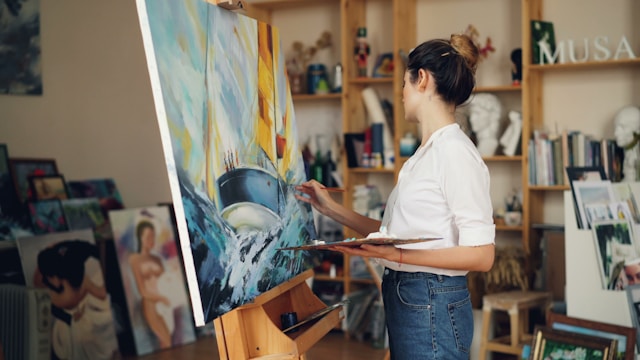
A photo of hobbies

German Hobbies Vocabulary

Start with the most common words, then expand your knowledge with intermediate and advanced vocabulary.

Beginner (A1)

  • play baseball Baseball spielen
  • play basketball Basketball spielen
  • to chat sich unterhalten
  • to cook kochen
  • to dance tanzen
  • to draw zeichnen
  • to fish angeln
  • to garden gärtnern
  • go for a walk spazieren gehen
  • go to the movies ins Kino gehen
  • go to the theater ins Theater gehen
  • listen to music Musik hören
  • to paint malen
  • play cards Karten spielen
  • play guitar Gitarre spielen
  • play video games Videospiele spielen
  • to read lesen
  • dance salsa Salsa tanzen
  • to sing singen
  • play soccer Fußball spielen
  • to swim schwimmen
  • take pictures fotografieren
  • take care of pets sich um Haustiere kümmern
  • dance tango Tango tanzen
  • play tennis Tennis spielen
  • go camping zelten gehen
  • go shopping einkaufen gehen
  • practice yoga Yoga machen
  • go to the beach an den Strand gehen
  • go to the disco in den Club gehen
  • work out Sport machen
  • travel reisen
  • visit museums Museen besuchen
  • play volleyball Volleyball spielen
  • watch films Filme schauen
  • do arts and crafts basteln
  • bake backen
  • cycle Rad fahren
  • play piano Klavier spielen
  • ski Ski fahren

Elementary (A2)

  • play badminton Badminton spielen
  • play beach volleyball Beachvolleyball spielen
  • play board games Brettspiele spielen
  • box boxen
  • play chess Schach spielen
  • go climbing klettern gehen
  • play darts Dart spielen
  • fly kites Drachen steigen lassen
  • play American football American Football spielen
  • play golf Golf spielen
  • do gymnastics turnen
  • play hockey Hockey spielen
  • listen to jazz Jazz hören
  • go jogging joggen gehen
  • knit stricken
  • play bass Bass spielen
  • play drums Schlagzeug spielen
  • play violin Geige spielen
  • play pool/billiards Billard spielen
  • do puzzles puzzeln
  • ride horses reiten
  • go sailing segeln gehen
  • go scuba diving tauchen gehen
  • skateboard Skateboard fahren
  • skate Inlineskaten
  • surf surfen
  • go out for a drink etwas trinken gehen
  • meditate meditieren
  • practice karate Karate machen
  • do track and field Leichtathletik machen

Intermediate & Advanced (B1-C1)

  • do carpentry mit Holz arbeiten
  • crochet häkeln
  • sew nähen
  • study astronomy Astronomie studieren
  • go bungee jumping Bungee-Jumping machen
  • create jewelry Schmuck herstellen
  • fix cars Autos reparieren
  • fly drones Drohnen fliegen lassen
  • hunt jagen
  • climb mountains Berge besteigen
  • write music Musik komponieren
  • write poetry Gedichte schreiben
  • watch birds Vögel beobachten
  • build models Modelle bauen
  • write songs Lieder schreiben

Practice What You've Learned

Review your German hobbies vocabulary and test your knowledge with interactive practice.

Ready to take the quiz?

Put your new hobbies vocabulary into practice and see how many words you can remember.

Take the quiz

Practice with flashcards

Review German hobbies vocabulary and strengthen your memory with interactive flashcards.

Open flashcards

Example Sentences

In proper context. With highlighted verbs and adjectives.

Beginner & Elementary (A1-A2)

Basic sentences describing common everyday hobbies, actions, and simple characteristics.

  • Ich backe am Wochenende einen Kuchen. I bake a cake on the weekend.
  • Wir tanzen jeden Freitagabend Salsa. We dance salsa every Friday evening.
  • Mein Bruder kocht sehr gern für Freunde. My brother likes cooking for friends very much.
  • Die Kinder malen schöne Bilder. The children paint beautiful pictures.
  • Im Sommer schwimme ich oft im See. In summer I often swim in the lake.
  • Das Kartenspiel ist wirklich lustig. The card game is really fun.
  • Das Training war heute sehr anstrengend. The training was very exhausting today.
  • Fußball ist in Deutschland sehr beliebt. Soccer is very popular in Germany.
  • Beim Lesen ist es im Zimmer ganz leise. While reading, it is very quiet in the room.
  • Dieser Film ist unglaublich spannend. This movie is incredibly exciting.

Intermediate & Advanced (B1-C1)

More complex constructions featuring specialized leisure activities and descriptive terms.

  • Sie näht ihre Kleidung oft selbst. She often sews her clothes herself.
  • Im Herbst jagt der Förster im Wald. In autumn, the forester hunts in the forest.
  • Meine Großmutter häkelt eine warme Decke. My grandmother crochets a warm blanket.
  • Er komponiert moderne Musik am Klavier. He composes modern music on the piano.
  • Wir beobachten seltene Vögel im Naturschutzgebiet. We observe rare birds in the nature reserve.
  • Handarbeit ist eine sehr kreative Beschäftigung. Crafting is a very creative activity.
  • Sie ist beim Tanzen sehr leidenschaftlich. She is very passionate when dancing.
  • Das Bauen von Modellen ist ziemlich zeitaufwendig. Building models is quite time-consuming.
  • Mein neues Hobby ist extrem abwechslungsreich. My new hobby is extremely varied.
  • Das Tauchen kann ein recht kostspieliges Hobby sein. Diving can be quite an expensive hobby.

Frequently Asked Questions

Everything you need to know about talking about leisure activities and hobbies in German.

There are a few standard ways to ask what someone likes to do in their free time depending on formality:

  • Informal: Was machst du in deiner Freizeit? (What do you do in your free time?)
  • Informal: Was sind deine Hobbys? (What are your hobbies?)
  • Formal: Was machen Sie in Ihrer Freizeit? (What do you do in your free time?)
  • Asking preference: Was machst du am liebsten? (What do you like doing most?)

German uses three primary verbs to talk about pursuing hobbies:

  • spielen (to play): Used for games, sports with balls, and instruments (e.g., Fußball spielen, Gitarre spielen, Schach spielen).
  • machen (to do/make): Used for general sports, fitness, and activities (e.g., Sport machen, Yoga machen, Fotos machen).
  • gehen (to go): Used with infinitives for outings or outdoor movement (e.g., spazieren gehen, zelten gehen, schwimmen gehen).

Unlike English, standard German does not require prepositions like 'on' or 'the' when stating that you play a sport or instrument:

  • Say Ich spiele Klavier. (NOT Ich spiele auf dem Klavier).
  • Say Er spielt Tennis. (NOT Er spielt das Tennis).
  • For listening, however, use hören direct or with zu: Ich höre Musik or Ich höre der Musik zu.

To share your opinions on activities, these common descriptive adjectives are very useful:

  • entspannend (relaxing) — Gärtnern ist sehr entspannend.
  • anstrengend (exhausting/demanding) — Boxen ist ziemlich anstrengend.
  • kreativ (creative) — Malen ist ein kreatives Hobby.
  • zeitaufwendig (time-consuming) — Modellbau ist zeitaufwendig.

Yes, German-speaking regions often use distinct vocabulary for common recreational activities:

  • In Switzerland, 'cycling' is Velo fahren, whereas in Germany and Austria it is Rad fahren or Fahrrad fahren.
  • In Austria and Southern Germany, casual kickaround soccer is often called tschutten or bolzen.
  • Sledding in winter is called rodeln in Germany and Austria, but schlitteln in Switzerland.

Explore All German Lessons

Browse all German vocabulary lessons, quizzes, grammar guides, and learning resources.

Browse All Lessons

Photo by Vitaly Gariev on Unsplash