Vocabulary Lesson

German Weather Vocabulary

In this short lesson, you'll master essential weather vocabulary in German. After learning the words, use the flashcards or quiz to reinforce your knowledge.
A1-C1 Audio Included Quiz Flashcards
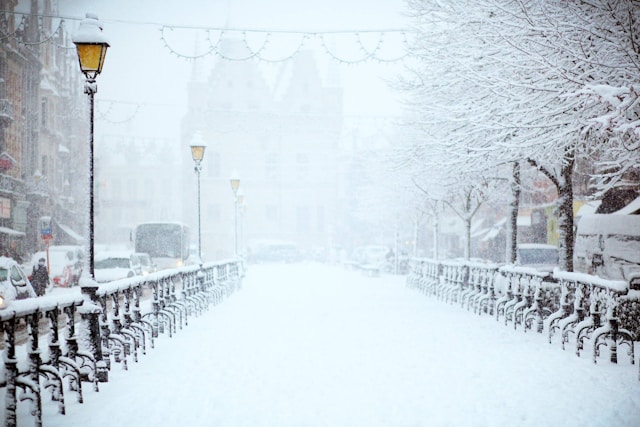
A photo of weather

German Weather Vocabulary

Start with the most common words, then expand your knowledge with intermediate and advanced vocabulary.

Beginner (A1)

  • ice das Eis
  • weather das Wetter
  • spring der Frühling
  • winter der Winter
  • autumn der Herbst
  • summer der Sommer
  • sky der Himmel
  • rain der Regen
  • umbrella der Regenschirm
  • snow der Schnee
  • wind der Wind
  • season die Jahreszeit
  • sun die Sonne
  • cloud die Wolke

Elementary (A2)

  • thunderstorm das Gewitter
  • lightning der Blitz
  • thunder der Donner
  • frost der Frost
  • hail der Hagel
  • fog der Nebel
  • drizzle der Nieselregen
  • rainbow der Regenbogen
  • shower der Schauer
  • snowfall der Schneefall
  • sunrise der Sonnenaufgang
  • sunshine der Sonnenschein
  • sunset der Sonnenuntergang
  • storm der Sturm
  • clear sky ein klarer Himmel
  • heat die Hitze
  • snowflake die Schneeflocke
  • temperature die Temperatur
  • forecast die Vorhersage

Intermediate & Advanced (B1-C1)

  • flood das Hochwasser
  • climate das Klima
  • thermometer das Thermometer
  • mist der Dunst
  • icicle der Eiszapfen
  • slush der Matsch
  • sleet der Schneeregen
  • blizzard der Schneesturm
  • smog der Smog
  • tornado der Tornado
  • downpour der Wolkenbruch
  • breeze die Brise
  • gust die Böe
  • heatwave die Hitzewelle
  • avalanche die Lawine
  • overcast die Wolkendecke
  • air pressure der Luftdruck
  • monsoon der Monsun
  • precipitation der Niederschlag
  • hurricane der Orkan
  • gale der Sturmwind
  • dew der Tau
  • whirlwind der Wirbelsturm
  • cyclone der Zyklon
  • cloudiness die Bewölkung
  • drought die Dürre
  • front die Front
  • cold front die Kaltfront
  • humidity die Luftfeuchtigkeit
  • snow cover die Schneedecke
  • snowdrift die Schneeverwehung
  • warm front die Warmfront
  • wind speed die Windgeschwindigkeit
  • wind chill die Windkühle
  • wind direction die Windrichtung
  • barometer das Barometer
  • condensation die Kondensation
  • evaporation die Verdunstung

Practice What You've Learned

Review your German weather vocabulary and test your knowledge with interactive practice.

Ready to take the quiz?

Put your new weather vocabulary into practice and see how many words you can remember.

Take the quiz

Practice with flashcards

Review German weather vocabulary and strengthen your memory with interactive flashcards.

Open flashcards

Example Sentences

In proper context. With highlighted verbs and adjectives.

Beginner & Elementary (A1-A2)

Basic weather verbs and descriptive adjectives for everyday conversation.

  • Im Herbst regnet es sehr oft. In autumn it rains very often.
  • Im Winter schneit es in den Bergen. In winter it snows in the mountains.
  • Die Sonne scheint heute den ganzen Tag. The sun is shining all day today.
  • Bei Frost friert das Wasser im Garten. During frost, the water in the garden freezes.
  • Draußen stürmt es seit heute Morgen. It has been storming outside since this morning.
  • Der Wind ist heute besonders kalt. The wind is particularly cold today.
  • Im Frühling wird das Wetter rasch warm. In spring, the weather quickly becomes warm.
  • Der Himmel ist heute nachmittag stark bewölkt. The sky is heavily cloudy this afternoon.
  • An der Küste ist es oft sehr windig. It is often very windy on the coast.
  • Die Sonne macht den Sommer extrem heiß. The sun makes the summer extremely hot.

Intermediate & Advanced (B1-C1)

More advanced verbs and atmospheric descriptors for weather forecasts and climate discussions.

  • Die Temperatur steigt am Nachmittag deutlich an. The temperature rises significantly in the afternoon.
  • Der Luftdruck sinkt vor einem starken Gewitter. The atmospheric pressure drops before a heavy thunderstorm.
  • Das Regenwasser verdunstet in der Hitze schnell. The rainwater evaporates quickly in the heat.
  • Eine kühle Brise weht durch die Bäume. A cool breeze blows through the trees.
  • Der Himmelsbereich klärt sich langsam auf. The sky is slowly clearing up.
  • Vor dem Gewitter ist die Luft extrem schwül. Before the thunderstorm, the air is extremely humid and muggy.
  • Am Morgen war die Straße sehr neblig. In the morning, the road was very foggy.
  • Die Luftfeuchtigkeit macht das Klima recht feucht. The humidity makes the climate quite damp.
  • Die lang anhaltende Dürre hinterlässt trockenen Boden. The prolonged drought leaves behind dry soil.
  • Die Nächte im Spätherbst werden bereits frostig. The nights in late autumn are already becoming frosty.

Frequently Asked Questions

Frequently asked questions about weather vocabulary and usage in German.

Talking about current weather conditions usually involves impersonal structures or specific active verbs.

  • Use Es ist... with weather adjectives: Es ist sonnig (It is sunny), Es ist windig (It is windy), or Es ist kalt (It is cold).
  • Use Es... with verbs: Es regnet (It is raining), Es schneit (It is snowing), or Es friert (It is freezing).
  • Saying Die Sonne scheint (The sun is shining) is often more natural in native conversations than Es ist sonnig.

German uses several specialized terms to distinguish between different types and intensities of rainfall.

  • der Nieselregen: A light, very fine drizzle or mist-like rain.
  • der Schauer: A brief, sudden shower of rain that usually clears up quickly.
  • der Wolkenbruch: A sudden torrential downpour or cloudburst with high volumes of water.

Here are standard phrases used to start small talk about weather conditions.

  • Wie ist das Wetter heute? (How is the weather today?)
  • Wie viel Grad sind es draußen? (What is the temperature outside?)
  • Wie wird das Wetter morgen? (What will the weather be like tomorrow?)

German features specific compound nouns for winter precipitations and hazardous ice conditions.

  • der Schneeregen: Sleet (a mixture of rain and snow falling together).
  • der Matsch / Schneematsch: Wet, dirty slush on roads or sidewalks.
  • das Glatteis: Black ice or slick ice forming on road surfaces.

While standard German is universally understood, regional preferences exist across Germany, Austria, and Switzerland.

  • In Switzerland, umbrella is often called der Parapluie alongside Regenschirm.
  • In Austria, drizzle is frequently called der Sprühregen rather than Nieselregen.
  • Sudden local downpours are often called der Platzregen in Southern Germany and Austria.

Explore All German Lessons

Browse all German vocabulary lessons, quizzes, grammar guides, and learning resources.

Browse All Lessons

Photo by Filip Bunkens on Unsplash