Vocabulary Lesson

Italian Body Vocabulary

In this short lesson, you'll master essential body vocabulary in Italian. After learning the words, use the flashcards or quiz to reinforce your knowledge.
A1-C1 Audio Included Quiz Flashcards
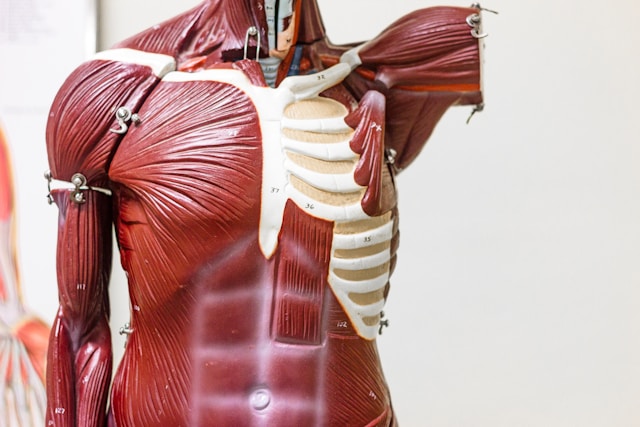
A photo of body

Italian Body Vocabulary

Start with the most common words, then expand your knowledge with intermediate and advanced vocabulary.

Beginner (A1)

  • hair i capelli
  • arm il braccio
  • neck il collo
  • body il corpo
  • heart il cuore
  • tooth il dente
  • finger il dito
  • knee il ginocchio
  • lip il labbro
  • nose il naso
  • chest il petto
  • foot il piede
  • face il viso
  • eye l'occhio
  • ear l'orecchio
  • beard la barba
  • mouth la bocca
  • forehead la fronte
  • leg la gamba
  • tongue la lingua
  • hand la mano
  • skin la pelle
  • back la schiena
  • shoulder la spalla
  • head la testa
  • stomach lo stomaco

Elementary (A2)

  • mustache i baffi
  • brain il cervello
  • eyelash il ciglio
  • toe l'alluce
  • liver il fegato
  • hip il fianco
  • elbow il gomito
  • middle finger il medio
  • chin il mento
  • little finger il mignolo
  • little toe il mignolo del piede
  • muscle il muscolo
  • palm il palmo
  • thumb il pollice
  • wrist il polso
  • breast il seno
  • eyebrow il sopracciglio
  • heel il tallone
  • big toe l'alluce
  • ring finger l'anulare
  • index finger l'indice
  • belly button l'ombelico
  • bone l'osso
  • nail l'unghia
  • ankle la caviglia
  • thigh la coscia
  • throat la gola
  • cheek la guancia
  • wrinkle la ruga
  • waist la vita

Intermediate & Advanced (B1-C1)

  • buttocks i glutei
  • skull il cranio
  • mole il neo
  • nerve il nervo
  • lung il polmone
  • calf il polpaccio
  • kidney il rene
  • abdomen l'addome
  • armpit l'ascella
  • forearm l'avambraccio
  • intestine l'intestino
  • collarbone la clavicola
  • rib la costola
  • freckle la lentiggine
  • jaw la mascella
  • nostril la narice
  • knuckle la nocca
  • eyelid la palpebra
  • goosebump la pelle d'oca
  • sole (of foot) la pianta del piede
  • temple la tempia
  • shin la tibia
  • vein la vena
  • diaphragm il diaframma
  • Adam's apple il pomo d'Adamo
  • tendon il tendine
  • arch (of foot) l'arco plantare
  • artery l'arteria
  • joint l'articolazione
  • esophagus l'esofago
  • groin l'inguine
  • cartilage la cartilagine
  • spine la colonna vertebrale
  • rib cage la gabbia toracica
  • gland la ghiandola
  • bladder la vescica

Practice What You've Learned

Review your Italian body vocabulary and test your knowledge with interactive practice.

Ready to take the quiz?

Put your new body vocabulary into practice and see how many words you can remember.

Take the quiz

Practice with flashcards

Review Italian body vocabulary and strengthen your memory with interactive flashcards.

Open flashcards

Example Sentences

In proper context. With highlighted verbs and adjectives.

Beginner & Elementary (A1-A2)

Useful everyday sentences describing parts of the body.

  • Lui piega il ginocchio durante l'esercizio. He bends his knee during the exercise.
  • Il bambino muove la mano per salutare. The child moves his hand to say goodbye.
  • Io mi lavo le mani prima di mangiare. I wash my hands before eating.
  • Il medico tocca la spalla dolorante. The doctor touches the sore shoulder.
  • Lei chiude gli occhi per riposare. She closes her eyes to rest.
  • Marco ha i capelli biondi e corti. Marco has blonde and short hair.
  • La mia pelle è molto asciutta d'inverno. My skin is very dry in winter.
  • Il mio corpo si sente stanco stasera. My body feels tired tonight.
  • Ha un collo lungo come una giraffa. He has a long neck like a giraffe.
  • La sua barba è completamente bianca. His beard is completely white.

Intermediate & Advanced (B1-C1)

Advanced context sentences about human anatomy and health.

  • L'atleta soffre di un forte dolore alla caviglia. The athlete suffers from severe ankle pain.
  • La gabbia toracica protegge gli organi vitali. The rib cage protects the vital organs.
  • Il cuore batte più velocemente durante lo sforzo. The heart beats faster during exertion.
  • Questo allenamento rafforza i muscoli della schiena. This workout strengthens the back muscles.
  • Il sangue circola attraverso ogni vena e arteria. Blood circulates through every vein and artery.
  • La colonna vertebrale deve rimanere flessibile. The spinal column must remain flexible.
  • Ha la gola gonfia a causa dell'infezione. Her throat is swollen because of the infection.
  • L'unghia del pollice è estremamente sensibile. The thumbnail is extremely sensitive.
  • Ha un addome muscoloso grazie al nuoto. He has a muscular abdomen thanks to swimming.
  • Sento la muscolatura del collo contratta. I feel my neck muscles are tense.

Frequently Asked Questions

Everything you need to know about Italian body parts and anatomical terms.

Several Italian body parts are masculine singular but become feminine plural ending in -a. This is a leftover feature from Latin neuter plurals.

  • il braccio (arm) → le braccia (arms)
  • il dito (finger) → le dita (fingers)
  • il ginocchio (knee) → le ginocchia (knees)
  • il labbro (lip) → le labbra (lips)
  • l'osso (bone) → le ossa (bones)

No, Italians rarely use possessive adjectives like 'mio' or 'tuo' with body parts when the owner is obvious. Instead, they use definite articles and reflexive pronouns.

  • Say 'Mi lavo le mani' (I wash my hands) instead of 'Lavo le mie mani'.
  • Say 'Ti fa male la testa?' (Does your head hurt?) instead of 'Fa male la tua testa?'
  • Say 'Si è rotto il braccio' (He broke his arm) instead of 'Ha rotto il suo braccio'.

Italian contains many colorful idiomatic expressions that feature parts of the body.

  • In bocca al lupo! — 'In the wolf's mouth!' (Good luck!)
  • Avere le mani bucate — 'To have holes in one's hands' (To spend money freely)
  • Costare un occhio della testa — 'To cost an eye of the head' (To cost an arm and a leg)
  • Avere la testa tra le nuvole — 'To have one's head in the clouds' (To daydream)
  • Alzare il gomito — 'To raise the elbow' (To drink too much alcohol)

There are two main sentence structures in Italian to talk about aches and pains.

  • Avere mal di... + noun: Ho mal di testa (I have a headache), Ho mal di stomaco (I have a stomach ache), Ho mal di gola (I have a sore throat).
  • Fare male + indirect pronoun: Mi fa male la gamba (My leg hurts), Mi fanno male i piedi (My feet hurt).

Yes, diminutives ending in -ino or -etto are very common when talking to children or showing affection.

  • la panciail pancino (tummy)
  • i piedii piedini (little feet)
  • le manile manine (little hands)
  • gli occhigli occhietti (cute little eyes)

Explore All Italian Lessons

Browse all Italian vocabulary lessons, quizzes, grammar guides, and learning resources.

Browse All Lessons

Photo by Alan Calvert on Unsplash