Vocabulary Lesson

Spanish Body Vocabulary

In this short lesson, you'll master essential body vocabulary in Spanish. After learning the words, use the flashcards or quiz to reinforce your knowledge.
A1-C1 Audio Included Quiz Flashcards
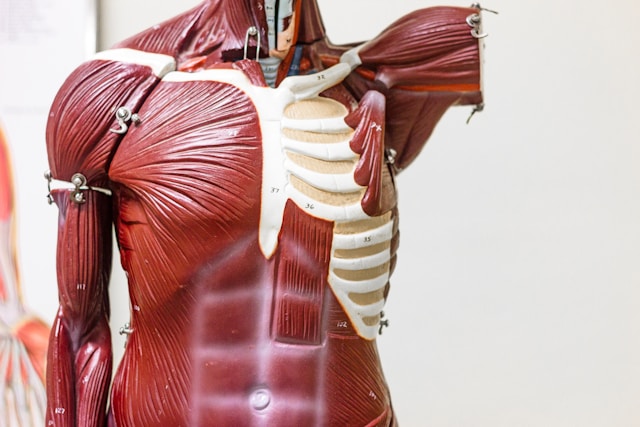
A photo of body}}

Spanish Body Vocabulary

Start with the most common words, then expand your knowledge with intermediate and advanced vocabulary.

Beginner (A1)

  • arm el brazo
  • elbow el codo
  • heart el corazón
  • neck el cuello
  • finger el dedo
  • tooth el diente
  • stomach el estómago
  • shoulder el hombro
  • lip el labio
  • eye el ojo
  • chest el pecho
  • hair el pelo
  • foot el pie
  • beard la barba
  • mouth la boca
  • head la cabeza
  • face la cara
  • back la espalda
  • forehead la frente
  • tongue la lengua
  • hand la mano
  • nose la nariz
  • ear la oreja
  • skin la piel
  • leg la pierna
  • knee la rodilla
  • fingernail la uña

Elementary (A2)

  • mustache el bigote
  • ring finger el dedo anular
  • middle finger el dedo corazón
  • toe el dedo del pie
  • little finger el dedo meñique
  • index finger el dedo índice
  • bone el hueso
  • thigh el muslo
  • thumb el pulgar
  • heel el talón
  • ankle el tobillo
  • chin la barbilla
  • hip la cadera
  • eyebrow la ceja
  • waist la cintura
  • throat la garganta
  • cheek la mejilla
  • wrist la muñeca
  • palm la palma
  • eyelash la pestaña
  • blood la sangre

Intermediate & Advanced (B1-C1)

  • brain el cerebro
  • skeleton el esqueleto
  • liver el hígado
  • mole el lunar
  • muscle el músculo
  • nerve el nervio
  • navel el ombligo
  • lung el pulmón
  • eyelid el párpado
  • sweat el sudor
  • wrinkle la arruga
  • armpit la axila
  • scar la cicatriz
  • rib la costilla
  • tear la lágrima
  • jaw la mandíbula
  • buttock la nalga
  • nape la nuca
  • calf la pantorrilla
  • freckle la peca
  • sole la planta del pie
  • saliva la saliva
  • temple la sien
  • vein la vena
  • intestine el intestino
  • pore el poro
  • kidney el riñón
  • artery la arteria
  • spine la columna vertebral
  • bladder la vejiga
  • spleen el bazo
  • pancreas el páncreas

Practice What You've Learned

Review your Spanish body vocabulary and test your knowledge with interactive practice.

Ready to take the quiz?

Put your new body vocabulary into practice and see how many words you can remember.

Take the quiz

Practice with flashcards

Review Spanish body vocabulary and strengthen your memory with interactive flashcards.

Open flashcards

Example Sentences

In proper context. With highlighted verbs and adjectives.

Beginner & Elementary (A1-A2)

Basic sentences about body parts using simple verbs and descriptive adjectives.

  • El cocinero se corta el dedo con el cuchillo. The cook cuts his finger with the knife.
  • Me duele el cuello después de trabajar todo el día. My neck hurts after working all day.
  • El niño mueve la mano para saludar a su mamá. The child moves his hand to wave at his mom.
  • Ella se lava la cara con agua fría por la mañana. She washes her face with cold water in the morning.
  • El médico me pide que abra la boca. The doctor asks me to open my mouth.
  • Tengo el pelo seco por el frío del invierno. I have dry hair because of the winter cold.
  • La piel de su rostro está roja por el sol. The skin on her face is red from the sun.
  • Ella tiene el pelo muy largo y rizado. She has very long, curly hair.
  • Tienes los pies muy fríos esta noche. Your feet are very cold tonight.
  • Mi abuelo todavía tiene las piernas fuertes. My grandfather still has strong legs.

Intermediate & Advanced (B1-C1)

More complex anatomical descriptions and actions involving body functions.

  • El corazón late más rápido cuando hago ejercicio intenso. The heart beats faster when I do intense exercise.
  • El atleta suda mucho durante el entrenamiento matutino. The athlete sweats a lot during morning training.
  • El paciente respira profundamente para llenar los pulmones. The patient breathes deeply to fill the lungs.
  • La herida en la muñeca sangra un poco pero no es grave. The wound on the wrist bleeds a little, but it is not serious.
  • El estómago digiere los alimentos en un proceso complejo. The stomach digests food in a complex process.
  • La piel alrededor de los ojos es muy sensible. The skin around the eyes is very sensitive.
  • Su rostro estaba pálido después de escuchar la noticia. His face was pale after hearing the news.
  • Tengo el tobillo hinchado a causa de un mal paso. My ankle is swollen because of a misstep.
  • El nadador profesional tiene los hombros musculosos. The professional swimmer has muscular shoulders.
  • El doctor confirmó que la fractura de hueso no era grave. The doctor confirmed that the bone fracture was not serious.

Frequently Asked Questions

Learn essential grammar rules, idiomatic structures, and regional nuances for body parts in Spanish.

To say something hurts in Spanish, the most common verb is doler, which functions like gustar. You can also use the phrase tener dolor de....

  • Use me duele with singular nouns: Me duele la cabeza (My head hurts) or Me duele el cuello (My neck hurts).
  • Use me duelen with plural nouns: Me duelen los pies (My feet hurt) or Me duelen las rodillas (My knees hurt).
  • Use tengo dolor de... as an alternative: Tengo dolor de estómago (I have a stomachache).
  • Always use definite articles (el, la, los, las) rather than possessive adjectives (mi, mis) when talking about your own body parts with pain verbs.

In Spanish, when multiple people each perform an action using one of their own body parts, the body part noun stays in the singular.

  • Say Todos levantaron la mano (Everyone raised their hand) rather than las manos, assuming each person raised one hand.
  • Say Los niños se lavaron la cara (The children washed their faces) because each child possesses one face.
  • Pluralizing the noun (las caras) can sound as if each person has multiple faces or create unnecessary ambiguity.

Describing physical characteristics requires choosing between the verbs tener (to have) and llevar (to wear/have).

  • Use tener for hair length, hair color, and eye color: Tiene el pelo largo (S/he has long hair), Tiene los ojos verdes (S/he has green eyes).
  • Use llevar for facial hair, glasses, or hairstyles: Lleva barba y bigote (He has a beard and mustache).
  • Avoid possessive pronouns in direct physical descriptions: say Tiene la piel clara rather than Tiene su piel clara.

Actions performed on one's own body almost always use reflexive verbs in Spanish.

  • Lavarse: Me lavo las manos (I wash my hands).
  • Cortarse: Se cortó el pelo (S/he got a haircut / cut their hair) or Me corté el dedo (I cut my finger).
  • Romperse: Se rompió el brazo (S/he broke their arm).
  • The reflexive pronoun indicates ownership, so possessive words like mi or su are unnecessary.

While basic anatomical terms like cabeza or mano are standard everywhere, colloquial terms for body parts vary significantly by country.

  • Stomach / Belly: el estómago (standard), la barriga (Spain & Latin America), la panza (Mexico, Argentina, Colombia).
  • Buttocks: las nalgas (anatomical/standard), el trasero (polite/neutral), las pompas (Mexico), el culo (colloquial everywhere).
  • Belly button: el ombligo (universal), el pupo (colloquial in Ecuador, Colombia, and Bolivia).

Explore All Spanish Lessons

Browse all Spanish vocabulary lessons, quizzes, grammar guides, and learning resources.

Browse All Lessons

Photo by Alan Calvert on Unsplash