Vocabulary Lesson

Spanish Time Vocabulary

In this short lesson, you'll master essential time vocabulary in Spanish. After learning the words, use the flashcards or quiz to reinforce your knowledge.
A1-C1 Audio Included Quiz Flashcards
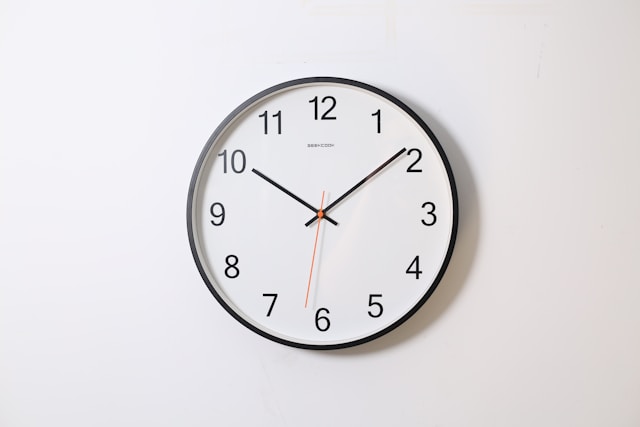
A photo of time}}

Spanish Time Vocabulary

Start with the most common words, then expand your knowledge with intermediate and advanced vocabulary.

Beginner (A1)

  • year el año
  • quarter (of an hour) el cuarto
  • day el día
  • weekend el fin de semana
  • month el mes
  • minute el minuto
  • moment el momento
  • second el segundo
  • time el tiempo
  • season la estación
  • date la fecha
  • hour la hora
  • morning la mañana
  • half (of an hour) la media
  • night la noche
  • week la semana
  • afternoon la tarde

Elementary (A2)

  • calendar el calendario
  • holiday el día festivo
  • schedule el horario
  • noon el mediodía
  • delay el retraso
  • century el siglo
  • age la edad
  • midnight la medianoche

Intermediate & Advanced (B1-C1)

  • dawn el amanecer
  • dusk el atardecer
  • working day el día laboral
  • business hours el horario comercial
  • instant el instante
  • period el período
  • deadline el plazo
  • semester el semestre
  • duration la duración
  • decade la década
  • sunset la puesta del sol
  • time zone la zona horaria
  • leap year el año bisiesto
  • trimester el trimestre
  • era la era
  • eternity la eternidad
  • generation la generación
  • fortnight la quincena
  • epoch la época

Practice What You've Learned

Review your Spanish time vocabulary and test your knowledge with interactive practice.

Ready to take the quiz?

Put your new time vocabulary into practice and see how many words you can remember.

Take the quiz

Practice with flashcards

Review Spanish time vocabulary and strengthen your memory with interactive flashcards.

Open flashcards

Example Sentences

In proper context. With highlighted verbs and adjectives.

Beginner & Elementary (A1-A2)

Simple sentences using basic time vocabulary.

  • Yo estudio español cada día. I study Spanish every day.
  • Ella trabaja ocho horas al día. She works eight hours a day.
  • Nosotros viajamos en el fin de semana. We travel on the weekend.
  • El bus llega en un cuarto de hora. The bus arrives in a quarter of an hour.
  • Mi cumpleaños es en el mes de junio. My birthday is in the month of June.
  • La clase es muy larga. The class is very long.
  • La noche está fría. The night is cold.
  • El horario es flexible. The schedule is flexible.
  • El momento fue perfecto. The moment was perfect.
  • El año pasado fue difícil. Last year was difficult.

Intermediate & Advanced (B1-C1)

More complex sentences with nuanced time expressions.

  • El proyecto se completó dentro del plazo establecido. The project was completed within the established deadline.
  • La empresa amplió su horario comercial. The company extended its business hours.
  • La conferencia se prolongó por toda la tarde. The conference dragged on for the whole afternoon.
  • El gobierno pospúsó la decisión hasta el próximo semestre. The government postponed the decision until next semester.
  • El sol se ocultó durante el atardecer. The sun hid during dusk.
  • La duración de la película es excesiva. The movie's duration is excessive.
  • El período de transición fue caótico. The transition period was chaotic.
  • La generación actual es muy digital. The current generation is very digital.
  • La época renacentista fue fascinante. The Renaissance epoch was fascinating.
  • El instante decisivo fue crucial. The decisive instant was crucial.

Frequently Asked Questions

Frequently Asked Questions about Spanish Time Vocabulary

To tell the time in Spanish, use ¿Qué hora es? (What time is it?) and the verb ser. Use Es la... for one o’clock and Son las... for all other hours. Add the minutes after the hour.

  • Es la una. (It's one o'clock.) - Use es la because una is singular.
  • Son las tres. (It's three o'clock.) - Use son las for hours other than one.
  • Son las cinco y diez. (It's 5:10.) - Add y followed by the minutes.
  • Son las siete y media. (It's 7:30.) - Y media means “and a half.”
  • Son las ocho y cuarto. (It's 8:15.) - Y cuarto means “and a quarter.”
  • Son las diez menos cuarto. (It's 9:45.) - Menos cuarto means “quarter to,” so the next hour is used.
  • Son las once menos diez. (It's 10:50.) - Menos diez means “ten minutes to” the next hour.
  • Son las dos de la tarde. (It's 2:00 p.m.) - Use de la mañana, de la tarde, or de la noche to specify the part of the day.

Discussing your routine involves combining time vocabulary with common verbs. Use these structures to describe your day.

  • Use empezar/comenzar a + time (to start at). Mi día empieza a las siete de la mañana.
  • Use durante + period (during/for). Tengo clase durante dos horas.
  • Use pasar + time (to spend time). Paso la tarde estudiando.
  • Use tardar en + infinitive (to take time to do something). Tardo media hora en llegar al trabajo.
  • Use dedicar + time + a (to dedicate time to). Dedico una hora al día al ejercicio.

Adjectives add detail when talking about durations, moments, or periods. Here are frequently used ones.

  • Largo/a (long) - un día largo
  • Corto/a (short) - un plazo corto
  • Exacto/a (exact/precise) - la hora exacta
  • Flexible (flexible) - un horario flexible
  • Puntual (punctual/on time) - una llegada puntual
  • Pasado/a (past/last) - el año pasado
  • Próximo/a (next) - la semana próxima
  • Breve (brief) - un momento breve
  • Eterno/a (eternal/seemingly endless) - una espera eterna

Verbs are the engine of sentences about time. These are essential for planning, describing, and discussing temporal events.

  • Ser (to be) - For telling time. Es la una.
  • Tener (to have) - For possession of time. Tengo poco tiempo.
  • Llegar (to arrive) - For arrivals. El tren llega a mediodía.
  • Empezar/Comenzar (to begin) - For start times. La reunión empieza a las tres.
  • Terminar/Acabarse (to finish/to run out) - For endings. El plazo se acaba mañana.
  • Durar (to last) - For duration. La película dura dos horas.
  • Posponer (to postpone) - For delays. Posponemos la cita.
  • Invertir (to invest) - For dedicating time purposefully. Invierto tiempo en aprender.

Yes, some words for time concepts differ significantly by country. Here are notable examples.

  • Fortnight: While la quincena is standard, in Argentina and Uruguay, you might also hear quincena used for a pay period, but the concept of a two-week period is often expressed as quince días (fifteen days).
  • Schedule/Timetable: In most places, it's el horario. In Chile, la hora can be used colloquially in this context (e.g., ¿Cuál es la hora de salida?).
  • Now/Right now: Ahora is universal. In Mexico and parts of Central America, ahorita is very common but can mean 'right now' or 'in a little while,' depending on context.
  • Delay: El retraso is standard. In Colombia and Venezuela, you might also hear la demora used frequently.
  • Business Hours: El horario comercial is common. In Spain, el horario de atención al público is also widely used.

Explore All Spanish Lessons

Browse all Spanish vocabulary lessons, quizzes, grammar guides, and learning resources.

Browse All Lessons
Photo by Ocean Ng on Unsplash