Vocabulary Lesson

German Days And Months Vocabulary

In this short lesson, you'll master essential days and months vocabulary in German. After learning the words, use the flashcards or quiz to reinforce your knowledge.
A1-C1 Audio Included Quiz Flashcards
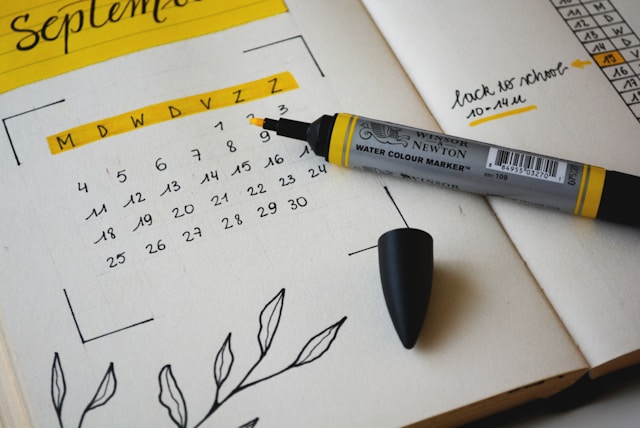
A photo of days and months

German Days And Months Vocabulary

Start with the most common words, then expand your knowledge with intermediate and advanced vocabulary.

Beginner (A1)

  • today heute
  • tomorrow morgen
  • yesterday gestern
  • year das Jahr
  • autumn der Herbst
  • winter der Winter
  • summer der Sommer
  • spring der Frühling
  • date das Datum
  • day der Tag
  • night die Nacht
  • morning der Morgen
  • afternoon der Nachmittag
  • week die Woche
  • season die Jahreszeit
  • January der Januar
  • February der Februar
  • March der März
  • April der April
  • May der Mai
  • June der Juni
  • July der Juli
  • August der August
  • September der September
  • October der Oktober
  • November der November
  • December der Dezember
  • Monday der Montag
  • Tuesday der Dienstag
  • Wednesday der Mittwoch
  • Thursday der Donnerstag
  • Friday der Freitag
  • Saturday der Samstag
  • Sunday der Sonntag
  • midday der Mittag
  • midnight die Mitternacht
  • month der Monat
  • evening der Abend
  • weekend das Wochenende

Elementary (A2)

  • day after tomorrow übermorgen
  • day before yesterday vorgestern
  • dawn die Morgendämmerung
  • calendar der Kalender
  • workday der Arbeitstag
  • holiday der Feiertag
  • schedule der Zeitplan

Intermediate & Advanced (B1-C1)

  • decade das Jahrzehnt
  • fortnight vierzehn Tage
  • dusk die Abenddämmerung
  • weekday der Werktag
  • semester das Semester
  • quarter das Quartal
  • era die Ära
  • century das Jahrhundert

Practice What You've Learned

Review your German days and months vocabulary and test your knowledge with interactive practice.

Ready to take the quiz?

Put your new days and months vocabulary into practice and see how many words you can remember.

Take the quiz

Practice with flashcards

Review German days and months vocabulary and strengthen your memory with interactive flashcards.

Open flashcards

Example Sentences

In proper context. With highlighted verbs and adjectives.

Beginner & Elementary (A1-A2)

Basic sentences featuring common verbs and adjectives with days, months, and seasons.

  • Am Montag arbeitet Paul im Büro. On Monday Paul works in the office.
  • Im Sommer reisen wir nach Spanien. In summer we travel to Spain.
  • Heute kaufen wir einen neuen Kalender. Today we are buying a new calendar.
  • Morgen besucht Maria ihre Großmutter. Tomorrow Maria visits her grandmother.
  • Gestern regnete es den ganzen Nachmittag. Yesterday it rained all afternoon.
  • Der Winter ist in den Bergen sehr kalt. The winter is very cold in the mountains.
  • Der Juli war ein sehr heißer Monat. July was a very hot month.
  • Ein schöner Frühlingstag macht alle Menschen glücklich. A beautiful spring day makes all people happy.
  • Am Wochenende schlafe ich gerne spät. On the weekend I like to sleep late.
  • Heute ist ein kurzer Arbeitstag. Today is a short workday.

Intermediate & Advanced (B1-C1)

Advanced example sentences showcasing time expressions in complex grammar structures.

  • Im letzten Jahrzehnt veränderte sich das Klima spürbar. In the last decade, the climate changed noticeably.
  • Der Vorstand plant das neue Projekt für das erste Quartal. The board plans the new project for the first quarter.
  • Wir verschieben die Konferenz auf das nächste Semester. We are postponing the conference to the next semester.
  • Die Archäologen erforschen eine vergessene Ära. The archaeologists are exploring a forgotten era.
  • In der Abenddämmerung spazieren die Senioren durch den Park. At dusk, the senior citizens stroll through the park.
  • Das vergangene Jahrhundert war historisch besonders bedeutsam. The past century was historically particularly significant.
  • Ein straffer Zeitplan ist für erfolgreiche Projekte wichtig. A tight schedule is important for successful projects.
  • An einem sonnigen Werktag sind die Straßen sehr belebt. On a sunny weekday, the streets are very busy.
  • Das vierte Quartal war finanziell außerordentlich erfolgreich. The fourth quarter was extraordinarily successful financially.
  • Nach vierzehn Tagen war der Patient wieder völlig gesund. After two weeks, the patient was completely healthy again.

Frequently Asked Questions

Frequently asked questions about days, months, and time expressions in German.

Capitalization rules in German time expressions depend on the grammatical role of the word:

  • Nouns representing days and months are always capitalized (e.g., der Montag, der Mai).
  • Times of day used as nouns are capitalized (e.g., der Morgen, der Abend).
  • When adverbial suffixes are added, they become lowercase (e.g., morgens = every morning, montags = on Mondays).
  • Words like heute, morgen, and gestern are adverbs and lowercased unless combined into a compound noun.

Choosing the correct preposition is essential for talking about dates and timeframes:

  • Use am (an + dem) for days and times of day (e.g., am Montag, am Morgen, am Wochenende).
  • Use im (in + dem) for months, seasons, and centuries (e.g., im Mai, im Sommer, im 21. Jahrhundert).
  • Use um for specific clock times (e.g., um Mitternacht, um 12 Uhr).
  • For standalone years, use no preposition or write 'im Jahr' (e.g., 2024 or im Jahr 2024).

German has concise single words for extended relative days:

  • vorgestern means 'the day before yesterday'.
  • übermorgen means 'the day after tomorrow'.
  • Both words are adverbs and are written in lowercase unless placed at the start of a sentence.
  • You can combine them with times of day, such as vorgestern Abend (the evening before last) or übermorgen Früh (the morning after tomorrow).

German uses ordinal numbers combined with prepositions when expressing dates in spoken and written form:

  • When stating the date with 'am', add an -ten ending to numbers up to 19 (e.g., am ersten Mai, am dritten Juli).
  • From 20 onwards, add an -sten ending (e.g., am zwanzigsten Dezember).
  • In written German, dates use dots after numbers (e.g., 1. Mai or 20. Dezember).
  • When stating today's date directly with 'Heute ist...', use nominative ordinals (e.g., Heute ist der erste Mai).

While standard German is widely understood, regional preferences exist for certain time words:

  • Samstag is universal across all regions, but Sonnabend is frequently used in Northern and Eastern Germany.
  • In Austria, Jänner is officially used alongside Januar for January.
  • The word heuer is widely used in Austria and Bavaria to mean 'this year' instead of dieses Jahr.

Explore All German Lessons

Browse all German vocabulary lessons, quizzes, grammar guides, and learning resources.

Browse All Lessons

Photo by Estée Janssens on Unsplash