Vocabulary Lesson

Spanish Days And Months Vocabulary

In this short lesson, you'll master essential days and months vocabulary in Spanish. After learning the words, use the flashcards or quiz to reinforce your knowledge.
A1-C1 Audio Included Quiz Flashcards
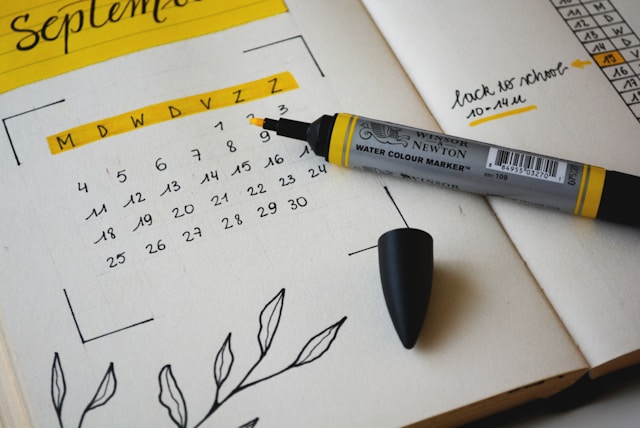
A photo of days and months}}

Spanish Days And Months Vocabulary

Start with the most common words, then expand your knowledge with intermediate and advanced vocabulary.

Beginner (A1)

  • year el año
  • calendar el calendario
  • day el día
  • holiday el día festivo
  • weekend el fin de semana
  • today hoy
  • tomorrow mañana
  • noon el mediodía
  • month el mes
  • moment el momento
  • season la estación
  • date la fecha
  • morning la mañana
  • midnight la medianoche
  • evening la tarde
  • week la semana
  • afternoon la tarde
  • Monday el lunes
  • Tuesday el martes
  • Wednesday el miércoles
  • Thursday el jueves
  • Friday el viernes
  • Saturday el sábado
  • Sunday el domingo
  • January enero
  • February febrero
  • March marzo
  • April abril
  • May mayo
  • June junio
  • July julio
  • August agosto
  • September septiembre
  • October octubre
  • November noviembre
  • December diciembre
  • yesterday ayer

Elementary (A2)

  • public holiday el día festivo
  • weekday el día laborable
  • period el período
  • schedule el horario

Intermediate & Advanced (B1-C1)

  • dawn el amanecer
  • anniversary el aniversario
  • dusk el atardecer
  • academic year el año académico
  • leap year el año bisiesto
  • cycle el ciclo
  • timeframe el plazo
  • semester el semestre
  • century el siglo
  • quarter (3 months) el trimestre
  • decade la década
  • full moon la luna llena
  • new moon la luna nueva
  • midweek la mitad de la semana
  • weeknight la noche entre semana
  • equinox el equinoccio
  • millennium el milenio
  • solstice el solsticio
  • age (historical period) la edad
  • era la era
  • generation la generación
  • timeline la línea de tiempo
  • fortnight la quincena
  • eve (day before) la víspera
  • epoch la época
  • chronology la cronología

Practice What You've Learned

Review your Spanish days and months vocabulary and test your knowledge with interactive practice.

Ready to take the quiz?

Put your new days and months vocabulary into practice and see how many words you can remember.

Take the quiz

Practice with flashcards

Review Spanish days and months vocabulary and strengthen your memory with interactive flashcards.

Open flashcards

Example Sentences

In proper context. With highlighted verbs and adjectives.

Beginner & Elementary (A1-A2)

Essential sentences for everyday conversations using basic days, months, and time expressions.

  • El concierto empieza el viernes por la noche. The concert starts on Friday night.
  • Nosotros viajamos a España en agosto. We travel to Spain in August.
  • Mi hermano cumple años en enero. My brother has his birthday in January.
  • ¿Tú trabajas el fin de semana? Do you work on the weekend?
  • El profesor anota la fecha en la pizarra. The teacher writes down the date on the board.
  • Hoy es un día caluroso de julio. Today is a hot day in July.
  • La reunión del lunes es corta. Monday's meeting is short.
  • Mañana será un día importante para la familia. Tomorrow will be an important day for the family.
  • El calendario está completo con todos los eventos del mes. The calendar is complete with all the events of the month.
  • El examen del miércoles es muy fácil. Wednesday's exam is very easy.

Intermediate & Advanced (B1-C1)

More complex sentence structures for discussing schedules, historical periods, and timeframes.

  • La empresa evalúa sus ganancias al final de cada trimestre. The company evaluates its profits at the end of each quarter.
  • No podemos postergar el informe más allá de la fecha límite. We cannot postpone the report beyond the deadline.
  • El arqueólogo estudia los restos de una época pasada. The archaeologist studies the remains of a past era.
  • El científico determina la cronología del fósil hallado. The scientist determines the chronology of the found fossil.
  • Los astronautas observan la luna llena durante la misión espacial. The astronauts observe the full moon during the space mission.
  • Este fenómeno astronómico ocurre únicamente en un año bisiesto. This astronomical phenomenon occurs only in a leap year.
  • El proyecto se dividirá en varios períodos de manera ordenada. The project will be divided into several periods in an orderly manner.
  • La revista publica un informe semestral sobre la economía nacional. The magazine publishes a biannual report on the national economy.
  • La víspera del evento fue una noche sumamente tranquila. The eve of the event was an extremely quiet night.
  • Durante el equinoccio, la duración de la luz solar es igual en todo el planeta. During the equinox, the duration of sunlight is equal across the entire planet.

Frequently Asked Questions

Essential rules, prepositions, and natural expressions for using Spanish days, months, and time periods.

Formatting dates in Spanish follows a consistent rule that differs slightly from English capitalization and word order.

  • Use the structure: el + [number] + de + [month] (+ de + [year]). For example: el 15 de septiembre de 2024.
  • Unlike English, days of the week and month names are not capitalized in Spanish unless they start a sentence (e.g., lunes, mayo).
  • To express the first day of a month, use el primero or el 1 (e.g., el primero de enero). Cardinal numbers are used for all other days.
  • The preposition en is used for months and years without a specific day: en julio, en 2025.

When speaking about dates, birthdays, and schedules, Spanish relies on a specific set of active verbs.

  • Caer en: Used to specify which day of the week a date falls on (e.g., Este año la Navidad cae en miércoles).
  • Cumplir: Used for birthdays and anniversaries to express reaching a specific age or milestone (e.g., Ella cumple años en junio).
  • Fijar / Programar: Used when setting dates or organizing schedules (e.g., Fijamos la fecha de la reunión).
  • Transcurrir / Pasar: Used to describe time passing or elapsed periods (e.g., El trimestre transcurrió rápidamente).

The word 'mañana' can mean either 'morning' or 'tomorrow' depending on the article and sentence position.

  • Mañana (without article): Means 'tomorrow' (e.g., Nos vemos mañana).
  • La mañana (with article): Means 'the morning' as a noun (e.g., La mañana está fresca).
  • Por la mañana / En la mañana: Means 'in the morning' (e.g., Tomo café por la mañana).
  • De la mañana: Used when specifying clock time, equivalent to 'a.m.' (e.g., A las ocho de la mañana).

Spanish features dedicated vocabulary for specific time intervals commonly used in work and academic contexts.

  • La quincena: Refers to a 15-day period or fortnight, often coinciding with biweekly paydays or vacations.
  • El trimestre: A three-month period or business quarter (Q1–Q4).
  • El semestre: A six-month period, standard for university academic terms.
  • La década / El siglo / El milenio: 10-year, 100-year, and 1000-year periods respectively.

Using the correct preposition before days and weekends is vital for natural speech in Spanish.

  • Use the definite article el for a single specific day: Nos vemos el lunes (See you on Monday).
  • Use the plural article los for recurring habits: Trabajo los sábados (I work on Saturdays).
  • Do not use the preposition en to say 'on Monday' or 'on weekends'—use el lunes or el fin de semana instead.
  • Use entre semana to mean 'during the week' or 'on weekdays'.

Explore All Spanish Lessons

Browse all Spanish vocabulary lessons, quizzes, grammar guides, and learning resources.

Browse All Lessons

Photo by Estée Janssens on Unsplash