Vocabulary Lesson

Spanish Fruits Vocabulary

In this short lesson, you'll master essential fruits vocabulary in Spanish. After learning the words, use the flashcards or quiz to reinforce your knowledge.
A1-C1 Audio Included Quiz Flashcards
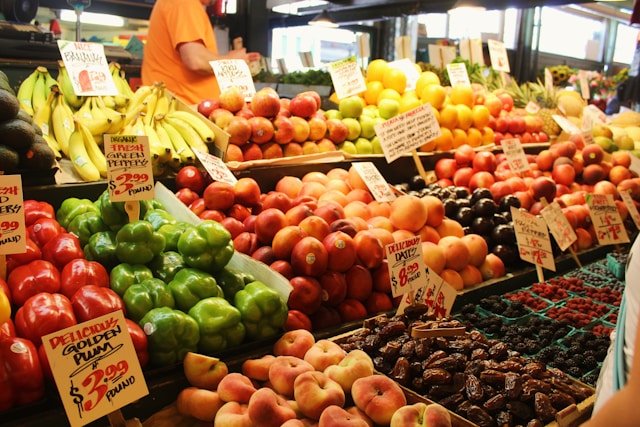
Assortment of fresh fruits for Spanish fruits vocabulary lesson

Spanish Fruit Vocabulary

Start with the most common fruits, then expand your vocabulary with intermediate and advanced fruit names.

Beginner (A1)

  • apple la manzana
  • banana el plátano
  • orange la naranja
  • strawberry la fresa
  • lemon el limón
  • pear la pera
  • grape la uva
  • pineapple la piña
  • watermelon la sandía
  • melon el melón

Elementary (A2)

  • peach el melocotón
  • cherry la cereza
  • mango el mango
  • kiwi el kiwi
  • coconut el coco
  • tangerine la mandarina
  • plum la ciruela
  • fig el higo
  • avocado el aguacate
  • raspberry la frambuesa

Intermediate & Advanced (B1-C1)

  • blueberry la arándano
  • blackberry la mora
  • pomegranate la granada
  • apricot el albaricoque
  • grapefruit el pomelo / la toronja
  • lime la lima
  • persimmon el caqui
  • passion fruit el maracuyá
  • papaya la papaya
  • guava la guayaba

Practice What You've Learned

Review your Spanish fruit vocabulary and test your knowledge with interactive practice.

Ready to take the quiz?

Put your new fruit vocabulary into practice and see how many words you can remember.

Take the quiz

Practice with flashcards

Review Spanish fruit vocabulary and strengthen your memory with interactive flashcards.

Open flashcards

Example Sentences

In the context of a market. With highlighted verbs and adjectives.

Beginner & Elementary (A1-A2)

Market interactions between customer and seller using A1/A2 vocabulary.

  • Yo quisiera un kilo de plátanos. I would like a kilo of bananas.
  • ¿Las naranjas están dulces? Are the oranges sweet?
  • Voy a llevar dos kilos de manzanas. I am going to take two kilos of apples.
  • ¿Tiene uvas rojas? Do you have red grapes?
  • ¿Puede pesar esta sandía, por favor? Can you weigh this watermelon, please?
  • ¿Qué fruta desea hoy? What fruit do you want today?
  • Estas fresas están muy frescas. These strawberries are very fresh.
  • Le recomiendo este melón. I recommend this melon to you.
  • Los limones están muy baratos hoy. The lemons are very cheap today.
  • ¿Le cobro todo junto? Shall I charge you everything together?

Intermediate & Advanced (B1-C1)

More natural market exchanges using B1–C1 vocabulary.

  • Prefiero elegir yo mismo la fruta de la cesta. I prefer to pick the fruit from the basket myself.
  • Busco kiwis que no estén demasiado ácidos. I am looking for kiwis that are not too sour.
  • Quisiera aprovechar la oferta de melocotones. I would like to take advantage of the offer on peaches.
  • ¿Tiene piñas de textura jugosa? Do you have pineapples with a juicy texture?
  • ¿Me puede descontar algo si llevo la caja entera? Can you give me a discount if I take the whole box?
  • Solemos importar este tipo de papayas en verano. We usually import this type of papaya in summer.
  • Esta variedad de manzana es extremadamente crujiente. This apple variety is extremely crunchy.
  • Le puedo garantizar que los higos son del día. I can guarantee you that the figs are fresh today.
  • Esta granada tiene un sabor agridulce muy particular. This pomegranate has a very unique bittersweet flavor.
  • Le sugiero conservar las fresas a temperatura ambiente. I suggest keeping the strawberries at room temperature.

Frequently Asked Questions

Essential tips on regional fruit names, market etiquette, weight expressions, and grammar rules.

Fruit vocabulary varies significantly by region due to local agricultural history and influences from indigenous languages. Common regional variations include:

  • Banana: Plátano (Spain/Mexico), Banana (Argentina/Uruguay), Guineo (Caribbean/Colombia).
  • Strawberry: Fresa (Spain/Mexico), Frutilla (Argentina/Chile).
  • Avocado: Aguacate (Spain/Mexico/Central America), Palta (South America).
  • Peach: Melocotón (Spain), Durazno (Latin America).
  • Pineapple: Piña (Most of Latin America & Spain), Ananá (Argentina/Uruguay).

In Spanish-speaking markets, fruit is primarily bought by weight (grams/kilos) or individual count. Common phrases include:

  • Un kilo de... (A kilogram of...)
  • Medio kilo de... (Half a kilo of... / 500g)
  • Un cuarto de kilo de... (A quarter kilo of... / 250g)
  • Una docena de... (A dozen of...)
  • Tres piezas de... (Three pieces of...)

To specify or ask about the readiness of fruit, use these essential adjectives and terms:

  • Maduro/a: Ripe (e.g., "Busco plátanos maduros.")
  • Verde: Unripe or green (e.g., "Esta pera todavía está verde.")
  • En su punto: Perfectly ripe / ready to eat right now.
  • Pasado/a or Sobremaduro/a: Overripe.
  • Madurar: To ripen (e.g., "Déjalas madurar un par de días.")

While most fruits ending in -a are feminine (la manzana, la fresa, la uva) and those ending in -o are masculine (el plátano, el durazno), watch out for masculine exceptions:

  • El limón (Lemon/Lime)
  • El melón (Melon)
  • El maracuyá (Passion fruit)
  • El aguacate (Avocado)

Tip: Tree names are usually masculine, whereas the fruit itself is feminine (e.g., el manzano = apple tree vs. la manzana = apple; el naranjo = orange tree vs. la naranja = orange).

When talking to vendor stalls (puestos de fruta), these natural expressions work best:

  • ¿A cómo está el kilo de...? (How much is a kilo of...?)
  • ¿Me pone medio kilo de...? (Could you give me half a kilo of...?)
  • ¿Puedo elegir yo mismo/a? (May I select them myself?) — Note: Always ask before touching open fruit!
  • ¿Tiene para probar? (Do you have a sample to taste?)

Explore All Spanish Lessons

Browse all Spanish vocabulary lessons, quizzes, grammar guides, and learning resources.

Browse All Lessons

Photo by Melissa Askew on Unsplash