Vocabulary Lesson

German Fruits Vocabulary

In this short lesson, you'll master essential fruits vocabulary in German. After learning the words, use the flashcards or quiz to reinforce your knowledge.
A1-C1 Audio Included Quiz Flashcards
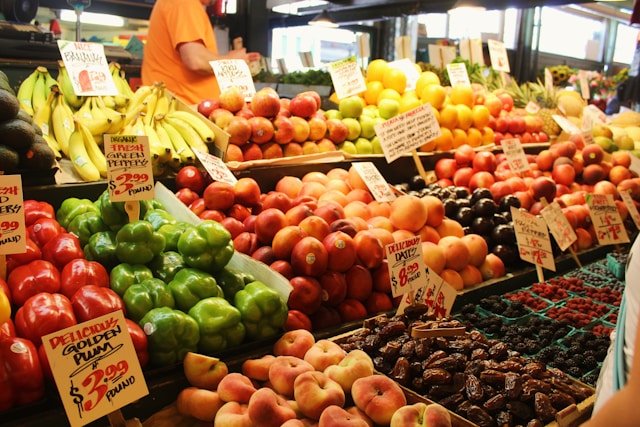
A photo of fruits

German Fruits Vocabulary

Start with the most common words, then expand your knowledge with intermediate and advanced vocabulary.

Beginner (A1)

  • fruit das Obst
  • apple der Apfel
  • peach der Pfirsich
  • pineapple die Ananas
  • banana die Banane
  • berry die Beere
  • pear die Birne
  • strawberry die Erdbeere
  • cherry die Kirsche
  • kiwi die Kiwi
  • melon die Melone
  • orange die Orange
  • plum die Pflaume
  • grape die Traube
  • watermelon die Wassermelone
  • lemon die Zitrone

Elementary (A2)

  • apricot die Aprikose
  • blackberry die Brombeere
  • cantaloupe die Cantaloup-Melone
  • clementine die Clementine
  • grapefruit die Grapefruit
  • blueberry die Heidelbeere
  • raspberry die Himbeere
  • honeydew melon die Honigmelone
  • coconut die Kokosnuss
  • lime die Limette
  • tangerine die Mandarine
  • mango die Mango
  • raisin die Rosine
  • citrus fruit die Zitrusfrucht

Intermediate & Advanced (B1-C1)

  • stone fruit das Steinobst
  • pomegranate der Granatapfel
  • avocado die Avocado
  • prune die Backpflaume
  • date die Dattel
  • fig die Feige
  • guava die Guave
  • persimmon die Kaki
  • lychee die Litschi
  • passion fruit die Maracuja
  • nectarine die Nektarine
  • olive die Olive
  • papaya die Papaya
  • satsuma die Satsuma
  • pomelo der Pomelo
  • rambutan der Rambutan
  • bilberry die Blaubeere
  • casaba melon die Casaba-Melone
  • custard apple die Cherimoya
  • dragon fruit die Drachenfrucht
  • goji berry die Goji-Beere
  • elderberry die Holunderbeere
  • jackfruit die Jackfrucht
  • currant die Johannisbeere
  • carambola die Karambole
  • plantain die Kochbanane
  • kumquat die Kumquat
  • mulberry die Maulbeere
  • mirabelle die Mirabelle
  • mirabelle plum die Mirabellenpflaume
  • cranberry die Preiselbeere
  • quince die Quitte
  • gooseberry die Stachelbeere
  • star fruit die Sternfrucht
  • tamarind die Tamarinde
  • boysenberry die Boysenbeere
  • breadfruit die Brotfrucht
  • damson die Damascenerpflaume
  • rowanberry die Eberesche
  • serviceberry die Felsenbirne
  • horned melon die Horngurke
  • jujube die Jujube
  • loganberry die Loganbeere
  • mangosteen die Mangostane
  • medlar die Mispel
  • greengage die Reneklode
  • sapodilla die Sapodilla
  • tamarillo die Tamarillo
  • loquat die Wollmispel
  • ackee die Aki
  • cloudberry die Moltebeere
  • salak die Schlangenfrucht
  • soursop die Stachelannone
  • ugli fruit die Ugli-Frucht

Practice What You've Learned

Review your German fruits vocabulary and test your knowledge with interactive practice.

Ready to take the quiz?

Put your new fruits vocabulary into practice and see how many words you can remember.

Take the quiz

Practice with flashcards

Review German fruits vocabulary and strengthen your memory with interactive flashcards.

Open flashcards

Example Sentences

In proper context. With highlighted verbs and adjectives.

Beginner & Elementary (A1-A2)

Basic sentences featuring everyday verbs and adjectives related to fruit.

  • Er isst jeden Morgen einen Apfel. He eats an apple every morning.
  • Sie schält die Banane für das Kind. She peels the banana for the child.
  • Wir schneiden die Wassermelone in Stücke. We cut the watermelon into pieces.
  • Ich kaufe frische Erdbeeren auf dem Markt. I buy fresh strawberries at the market.
  • Bitte wascht die Kirschen vor dem Essen. Please wash the cherries before eating.
  • Die reife Mango ist sehr süß. The ripe mango is very sweet.
  • Die Zitrone schmeckt extrem sauer. The lemon tastes extremely sour.
  • Auf dem Tisch steht frisches Obst. There is fresh fruit on the table.
  • Die Orange ist besonders saftig. The orange is especially juicy.
  • Die Pfirsiche sind bereits reif. The peaches are already ripe.

Intermediate & Advanced (B1-C1)

More complex structures and refined descriptive vocabulary for fruits.

  • Die Köchin entkernt den Granatapfel vorsichtig. The chef carefully seeds the pomegranate.
  • Er püriert die Himbeeren für die Fruchtsoße. He purees the raspberries for the fruit sauce.
  • Sie presst frischen Saft aus den Limetten. She presses fresh juice from the limes.
  • Die Datteln werden in der Sonne getrocknet. The dates are dried in the sun.
  • Der Gärtner pflückt reife Feigen vom Baum. The gardener picks ripe figs from the tree.
  • Die Drachenfrucht hat ein sehr exotisches Aussehen. The dragon fruit has a very exotic appearance.
  • Die Waldhimbeere schmeckt deutlich aromatischer als die Zuchtsorte. The wild raspberry tastes significantly more aromatic than the cultivated variety.
  • Diese schlechte Banane ist leider schon faul. This bad banana is unfortunately already rotten.
  • Viele Kunden bevorzugen kernlose Weintrauben. Many customers prefer seedless grapes.
  • Gedünstete Quitten gelten als besonders bekömmlich. Steamed quinces are considered particularly digestible.

Frequently Asked Questions

Essential guide to German fruit terminology, usage, and culinary expressions.

When purchasing or eating fruit in German-speaking countries, several adjectives are commonly used to describe flavor and texture:

  • reif (ripe) / unreif (unripe)
  • süß (sweet) vs. sauer (sour)
  • saftig (juicy) vs. trocken (dry)
  • mehlig (mealy/mushy, often used for overripe apples or pears)

Both terms translate to "fruit" in English, but they are used in distinct contexts in German:

  • das Obst is an uncountable collective noun for edible fruits as a general food category (e.g., Ich esse gern Obst.).
  • die Frucht (plural: die Früchte) refers to an individual piece of fruit, a biological fruit structure, or figurative fruits of labor.

German culinary and botanical vocabulary classifies fruits into clear groups:

  • das Steinobst (stone fruit such as peaches, plums, and cherries)
  • das Kernobst (pome fruit such as apples and pears)
  • das Beerenobst (berries such as strawberries, raspberries, and blueberries)
  • die Zitrusfrüchte (citrus fruits such as oranges, lemons, and limes)

Useful verbs for cooking, baking, and fruit preparation include:

  • schälen (to peel)
  • entkernen (to core or remove seeds)
  • schneiden or würfeln (to slice or dice)
  • pürieren (to blend or puree)

Yes, standard German and regional varieties frequently differ in fruit terminology:

  • Marille is used in Austria and South Tyrol for die Aprikose (apricot).
  • Zwetschge (or Zwetschke) refers to a specific plum cultivar popular across Southern Germany, Austria, and Switzerland.
  • Apfelsine is an older traditional Northern German term for die Orange.

Explore All German Lessons

Browse all German vocabulary lessons, quizzes, grammar guides, and learning resources.

Browse All Lessons

Photo by Melissa Askew on Unsplash